

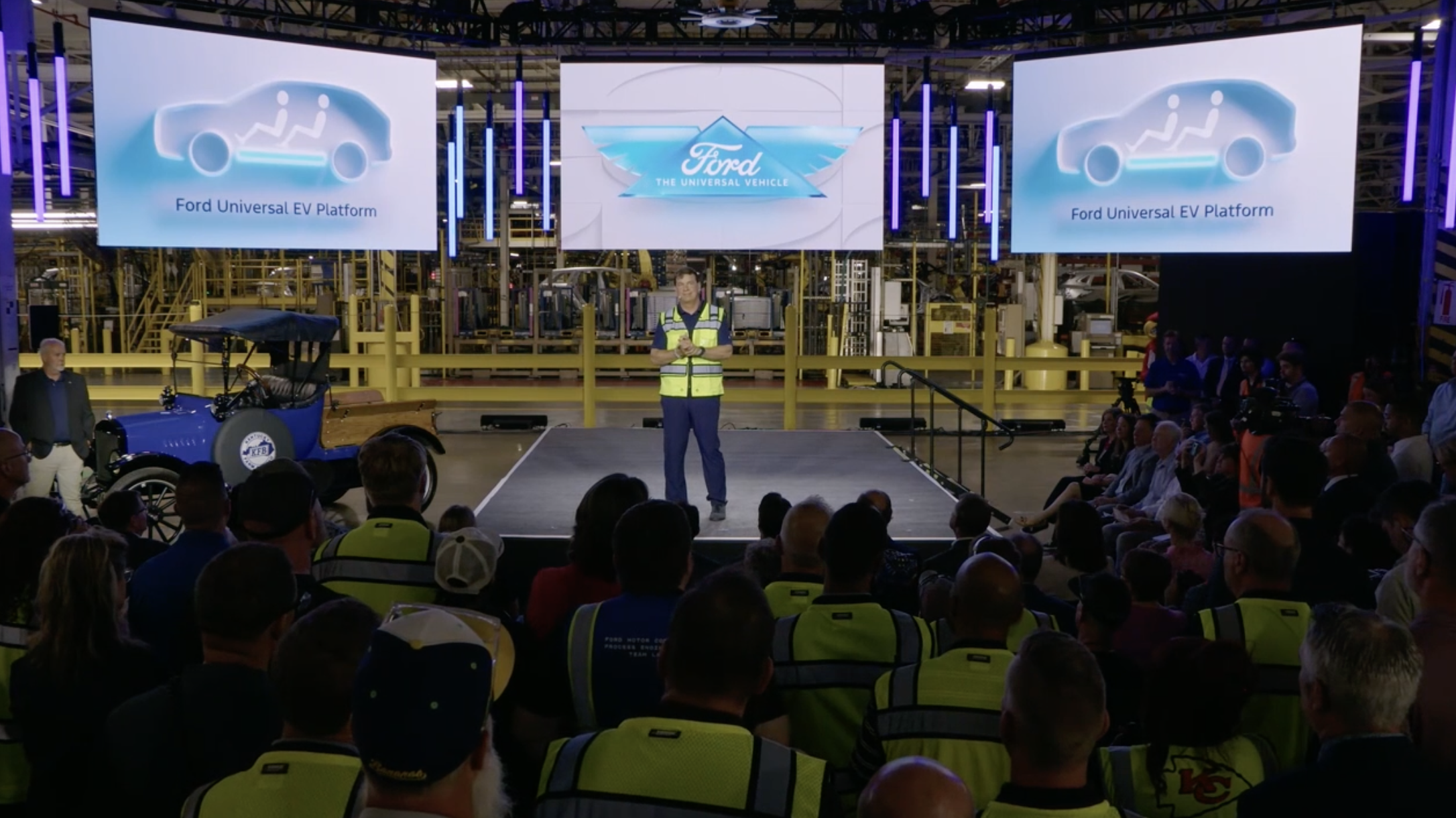
Ford says it will bring a midsize electric pickup with plenty of power and range to market in 2027 at a starting price of $30,000, thanks to innovations in design and manufacturing.
The truck – which Ford calls its new Model T moment – will be built on a newly developed universal EV platform and built at Ford’s sprawling Louisville, Ky. plant in a new modular assembly process designed to speed things with less stress and strain for workers.
The universal platform design – hashed out by a special team at a “skunkworks” facility in Long Beach, Ca. over the past three years – features a dramatic reduction in parts. It also is flexible. Ford is starting with a two-row midsize pickup, but showed silhouettes of a work van and two- and three-row SUVs on the same underpinnings.
The platform likely is of the so-called skateboard type, locating most of the powertrain, including motors and battery pack,in a modular package that underpins the separate vehicle body. General Motors uses one, originally called the Ultium platform – for its EVs.
The new truck and the new EV design and production system signal ford’s intent to do battle with Chinese EV makers who so far have cornered the global market for affordable electric vehivles.
Made in U.S.
The new pickup, according to Ford CEO Jim Farley, will have the footprint of today’s Maverick midsize pickup but more interior room than a Toyota RAV4, be quicker than a Mustang EcoBoost with sub 5-second 0-60 mpg acceleration, be able to power the average home for up to 6 days with juice from its battery pack, and deliver “amazing” range.
Both the truck and its batteries will be made at Ford plans in the U.S. – the truck in Kentucky and the batteries in Michigan.
Ford said that in addition to the $3 billion battery plant in Michigan, is scheduled to begin production in 2026, its plans for an electric future with domestic production include the almost $2 billion it will spend on the EV production component of its Louisville, Ky., assembly plant.
LFP Battery
Farley said the pickup, as well as other vehicles to be built on the new universal EV platform, will use lithium iron phosphate (LFP) batteries built at Ford’s new $3 billion battery plant in Michigan

LFP batteries provide better thermal stability and thus higher safety levels than other lithium battery chemistries. They also can handle more charge-discharge cycles, so are longer-lived, doesn’t use expensive minerals such as cobalt and nickel, and are about 35% cheaper than other EV battery types.
However, they also have about 30% less energy density than other lithium battery types, meaning that more cells – bigger and heavier battery packs – have been needed to deliver the same range.
That said, a pickup or SUV’s design typically provides more room than a sedan for batteries, so Ford should have no problem delivering on Farley’s “amazing” range promise. Ford’s standard range Mustang Mach-E uses LFP batteries and delivers an estimated 230 miles per charge. A midsize pickup should be able to beat that.
Fewer Parts
To keep costs down, Ford’s development team adopted the mantra that “the best part is no part,” said Ford EV chief Doug Field. The resulting pickup design is lighter so it can overcome the LFP chemistry’s lower energy density. It ended up needing 30% fewer batteries than a typical EV with the same range, Field said.
The design also eliminated 25% of the welds in the typical midsize pickup, uses only a quarter of the number of body parts thanks to developments in unicasting – a single cast aluminum piece incorporating what used to be dozens of individual parts – and one half the number of fasteners. It also lost 22 pounds of wiring, equivalent of 4,000 linear feet of wire.
Overall, there will be about 20% fewer parts in the new electric truck than in a conventional midzise pickup, the company said.
Quicker, Easier Production
Ford also developed a new style of production line for the electric truck and subsequent EVs – an assembly “tree” instead of a straight line.
In a traditional line, a vehicle is assembled in a liner fashion, requiring workers to reach into the body cavity as it rolls past to install seats and dashboards, for instance. In Ford’s new EV system, the vehicle will be divided into three modules that are put together on individual lines, or branches, that will come together for final assembly at the base, or trunk.

The front and rear sections of the vehicle will be assembled on their own lines, as will the skateboard platform, which will be fitted with the seats, console and carpeting before the front and rear modules are added.
Parts travel down the assembly tree to operators in a kit. Within that kit, all fasteners, scanners and power tools required for the job are included – in the correct orientation for use.
Workers won’t be required to reach up or behind themselves for fasteners or tools, enabling them to build the EVs with less physical stress from reaching, turning and stretching.
Ford expects completed vehicles to come off the assembly tree up to 15% faster than they would off an assembly line.
Making it Competitive
Ford cannot build in the U.S. and compete with Chinese EV makers on labor costs, said Field, so the new EV production system was developed to enable the company to better manage overall content and assembly costs. “We compete with the Chinese not on labor, but on innovation,” he said.
Although it has fewer individual parts, the truck itself – even the base version – won’t be a stripped-down budget model but will be “packed with innovative features” including “new software experiences” and over-the-air updates to seamlessly add new features over time, the company insists.