

With the federal $7,500 clean vehicle tax credit gone, automakers are scrambling close the affordability gap — trimming MSRPs, offering dealer and manufacturer rebates, and reshaping lease and finance programs.
The programs not only ease price shock for consumers, they help dealers avoid being stuck with big inventories of unsold EVs.
EV makers are using combinations of price cuts, rebates and purchase credits, and subsidized finance and lease programs to soften the blow from the end of the federal credit.
Luxury brands and high-volume manufacturers are, for the most part, absorbing some of the cost directly; smaller startups such as Rivian and Lucid face a tougher road.
The $7,500 credit for new EVs was baked into many buyers’ expectations. When it expired, purchase calculus changed.
Here’s a look at how EV makers are responding as the to avoid sales meltdowns in the absence of federal support.
Tesla
Tesla relies on its ability to institute and fine-tune rapid price changes and doesn’t use company-wide cash rebates. It has adjusted pricing and trim availability and just introduced two new content-reduced “Standard” trims for the Model 3 and Model Y to keep entry prices closer to what they’d been with the incentive.Tesla also is offering $6,500 lease adjustments for other Model 3 and Model Y trims.
Ford & General Motors
The two U.S. automakers initially planned to buy the EVs in their dealers’ inventories prior to the end of the federal incentive program on Sept. 30, claim the tax credit for themselves and then pass it along to consumers in the form of reduced lease rates.
Both subsequently changed tactics after a Republican congressman complained.
GM now says it will fund lease reductions out of its own pocket, at least through the end of October.
Ford, which only acknowledged dropping its original on Oct. 8, hasn’t commented on any new program but earlier had tentatively committed to offering reduced lease rates through the end of the year. Many Ford dealers have been advertising “equivalent value” lease cash and 0% financing on the Mustang Mach-E and F-150 Lightning inventories.
Stellantis (Chrysler, Dodge, Jeep, Ram, Fiat)
Stellantis is offering $7,500 rebates on dealer inventory of EVs and plug-in hybrids, through the end of October.
BMW
BMW is offering a $7,500 purchase credit through October on all of its EVs and a $5,000 credit on some plug-in hybrid models.
Honda, Nissan, Toyota
The three major Japanese brands are leaning on modest rebates for current EVs and emphasizing conventional and plug-in hybrids.
Nissan also has canceled its upscale Ariya EV for the U.S. market’s 2026 model year and will push its redesigned and lower-priced 2026 Leaf instead.
Hyundai Group (Hyundai, Kia, Genesis)
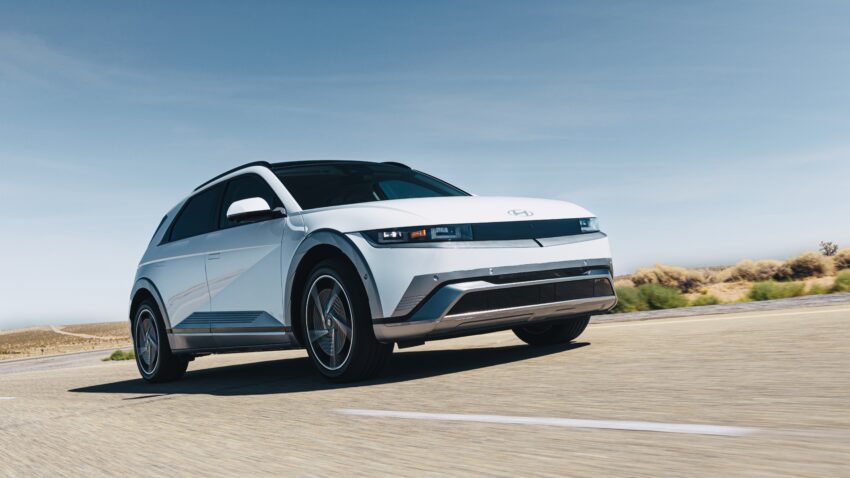
Hyundai slashed prices on its popular Ioniq 5 EV by up to $9,800 for 2026 models and is offering up to $7,500 in cash rebates on 2025 inventory.
Kia and Genesis are using dealer cash and promotional lease rates to keep existing 2025 inventory moving and also have reduced prices on some 2026 models – up to $2,0o0 on some Kia EV9 trims.
We also expect that Kia will cut pricing on the 2026 EV6 – the Ioniq 5’s corporate cousin – when it is launched nearer the end of the year.
Mercedes-Benz
Reading the tea leaves, Mercedes-Benz earlier this summer first slashed pricing on its EQE and EQS models and then announced that it would halt production of the electric vehicles for the U.S. market for an indefinite period so as not to be caught with a large inventory as EV sales slowed after the federal tax credits ended.
Volkswagen Group (VW, Audi, Porsche)
VW Group brands have mostly opted for targeted dealer incentives such as lease cash and loyalty incentives and are pulling back on planned launches in the U.S. market of new EVs and PHEVs.
Rivian and Lucid
These smaller, independent premium EV makers have offered short-term financing incentives and price adjustments to keep orders flowing.
Lucid is offering a $7,500 lease incentive through the end of the year , but only on its new Gravirty luxury electric SUV.
Rivian is offering discounts of $5,000 to $6,500 on its various models through the end of October.
Where it’s heading
What we’re seeing now is a patchwork of strategies, with deep discounts that can’t last – no automaker can afford to subsidize its EVs forever. If the industry can’t cut costs – and federal tariffs imposed by the Trump administration on imported steel, aluminum and auto parts and components are making cost-cutting difficult for some – EV production and model selection is likely to decline.
We expect to see a short-term slump in EV sales, but certainly not the death of the EV. The pace of sales growth may slow – Bloomberg New Energy is predicting a 27% market share for EVs by 2035, up from 10% in 2024 but down considerably from an earlier 2035 prediction of 47%. Global demand still exists, though, as does demand – varying state by state – in the U.S.
Having developed EV technology and demonstrated EVs’ superiority over gas- and diesel-burning vehicles in so many areas (quieter, cleaner, quicker and cheaper to operate), and in light of continued public and governmental pressure to curb fossil fuel consumption, automakers aren’t going to hurt their own competitiveness by stuffing the genie back into the bottle.