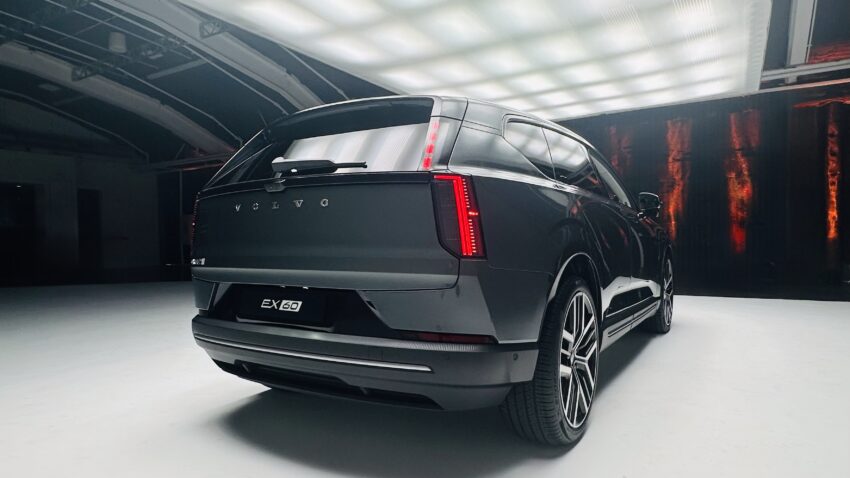
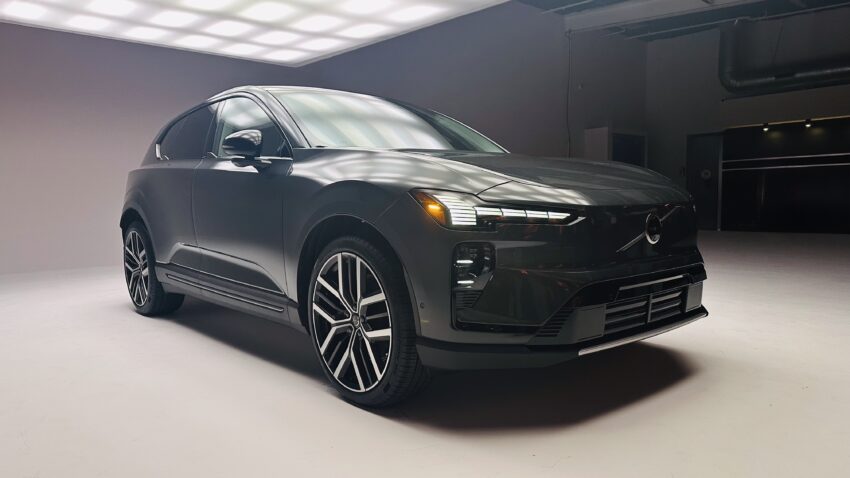
The 2027 EX60 is Volvo’s first all-electric entry in the hot midsize SUV segment and on paper it hits all the right notes for a successful EV: more than 300 miles of range – up for 400 miles for one version; super-quick DC fast charging speed; lots of power, plenty of room and a decent price.
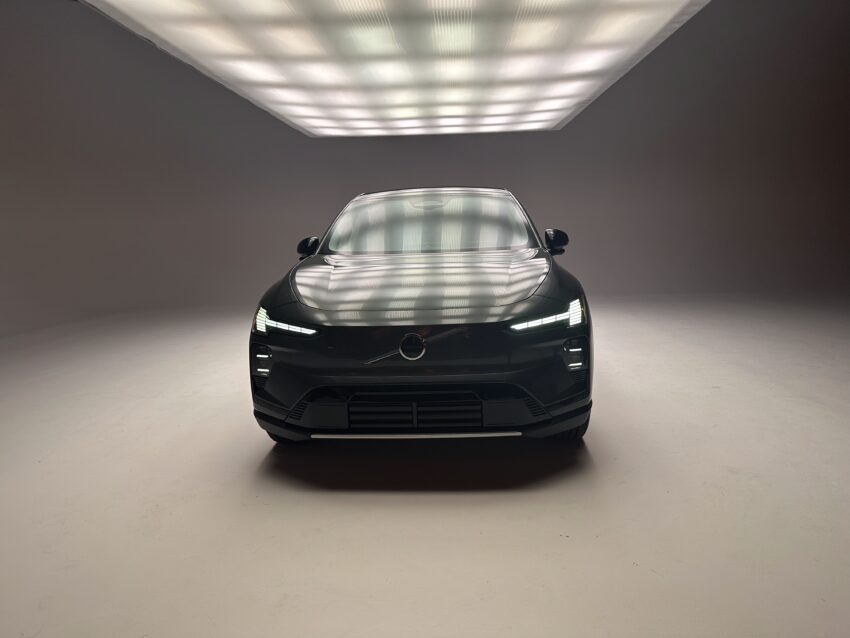
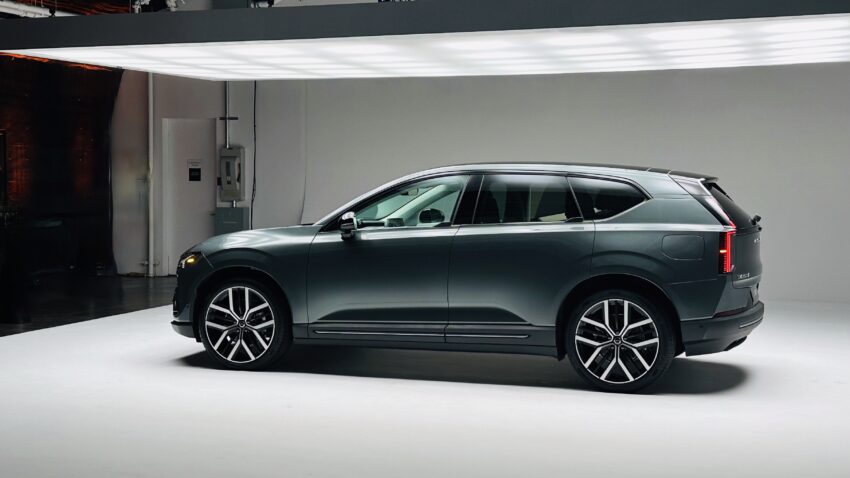
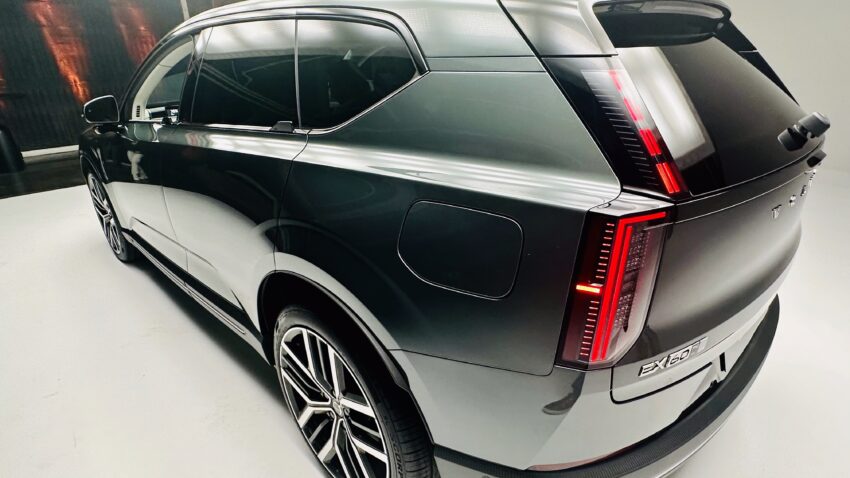
It also, in our opinion, is one of the nicest-looking Volvo SUVs in a long time. Yes, it sports the SUV world’s de rigueur slab-sidedness (e.g., the Hyundai Palisade, Kia EV9, Range Rover and upcoming 2027 Toyota Highlander, among others) but has softened edges, a rearward-sloping roofline and just enough curves to stand out from the pack. It’s a look that catches the eye and politely says “I’m different.”
It’s a little thing, but a feature we liked a lot are the “aerial wing” door handles that rise from the beltline at the base of each side window and look a lot like the “shark fin” antennae most cars sport today. They give the sheet metal on the doors a clean look and, Volvo says, channel air flow along the beltline, improving aerodynamics and adding a few miles to the EX60s range. So, maybe not such a little thing. They also are easier to grab and activate than handles built into the doors or window frames.
The difference s are more than external, though. Like its big brother, the EX90 introduced in 2024 as a ’25 model, the EX60 is what’s coming to be called a software-defined vehicle, its multitude of driver aid, safety and infotainment systems run by an ultra-fast “computer-on-a-chip” and kept fresh with over-the-air updates.
The Competitive Landscape
Volvo has problems in the U.S.
Quarterly sales have declined for three consecutive quarters, with first-quarter 2026 sales down a worrisome 32%. Its share of the U.S. luxury market has dropped to just under 6%, lowest for the company since 2019.
Part of that decline is likely due to U.S. tariff policy, which now discourages imports, and part is due to Volvo’s increasing push for electrification just as market interest shrinks in the face of the active opposition to EVs from the current occupant of the White House.
EVs, in fact, have been politicized in the U.S. for a number of years now, although federal policies designed to help increase acceptance – and sales – had received bipartisan support in Congress until last year, when federal subsidies were yanked away.
Still, automakers know that EVs are here to stay, even though sales aren’t likely to grow much until/unless policies change with a new administration and a public education campaign that accurately points up the advantages, in most cases, electric vehicles have over fossil-fuel burners.
That’s why, even as it announces that it is pulling its smallest and least-expensive EV – the EX30 – from the U.S. market at the end of the 2026 model year – Volvo is reading the launch of the larger and more expensive EX60.
It cannot afford to cede space in the two-row, five seat SUV segment – the hottest market segment in the U.S. – to EV competitors such as the BMW iX3 and Cadillac Lyriq. Launching the EX60 now also means Volvo could pick up sales, however weak the EV market remains, in the gap that will be left by Mercedes-Benz, which drops the midsize EQE SUV the the end of the 2026 model year and isn’t likely to have a replacement until 2028.
We are able to spend a few hours with a pre-production model of the EX60 earlier this month – production has just begun in Sweden for export to the U.S. – and we liked what we saw as well as what we heard from the Volvo reps at the event.
Techie Stuff
The EX60 is built around an 800-volt electrical system that isn’t just good for charging and light-weighting: It provides the basis for a sophisticated, Nvidia Drive-controlled array of safety and driver assistance systems, integrated with the infotainment system and all kept timely with over-the-air updates. Volvo says it will “raise the bar on safety and overall performance through data, software and AI (artificial intelligence).”
The formal name is dual NVIDIA DRIVE AGX Orin and it is largely the same system Volvo introduced with its 2025 EX90 large electric SUV. You can learn a little more about it, of you care to, by clicking here, for our look at the ’26 ES90 electric sedan, or here for Volvo’s take.
The infotainment system runs on Google software and the plain-language Gemini AI voice recognition system.
2027 Volvo EX60 Trims and Pricing
Model and trim specific pricing won’t be released until something in May, we’re told. But the model that will lead the launch should start at around $60,000 – level with or below most competitors.
The upcoming BMW iX3 will start at around $60,000, the company has said, with a more basic trim coming later at around $55,000. The 2026 Cadillac Lyriq begins at almost $61,000 and the 2026 Mercedes-Benz EXE SUV starts at almost $78,000 and it is unlikely that its successor will be cheaper.
The EX60 will have three powertrain levels, the P6 with a single-motor, rear-drive layout and 83 kilowatt-hour (80 kWh usable) battery; the P10 AWD with dual-motor, all-wheel drive and a 95 kWh battery (91 kWh usable), and the P12 AWD, with dual motor all-wheel drive and a 117 kWh battery (112 kWh usable).
Each versions will be available in three trim levels – Core, Plus and Ultra. The base Core trims, however, won’t be available until the second model year, which launches in late 2027.
While the P6 variants will be the least-expensive models, Volvo expects the EX60 P10 AWD to be the sales leader.
An outdoorsy Cross Country variant is expected in 2027 as a ’28 model and will feature adjustable air suspension, a wider track, bulgier fender flares and 0.8-inch more ground clearance than the standard versions’ 7.2 inches. Additionally, the air suspension can lower the Cross Country by up to 0.8 inches, and can raise it that much as well, we’re told.
EX60 Power, Performance
Volvo is rating the EX60 P6 at 369 horsepower and 354 lb.-ft. of torque, with a 5.7-second 0-60 mpg acceleration time.
The AWD versions add substantially to that because of their additional, front-mounted, motors.
The P10 is Volvo-rated at 503 hp and 524 lb.-ft. with a 4.4-second 0-60 time; the P12 at 670 hp, 583 lb.-ft. and a 3.8-second time from 0-60 mph.
Range
All versions of the 2027 EX60 will be built on Volvo’s new modular SPA3 EV platform (it can be altered to accommodate sedans and wagons as well as SUVs, and subcompacts to full-size models) that allows for improved battery design and widespread sharing of components for lower overall production costs.
The platform also enables 800-volt electrical architecture. That’s not only necessary for the speediest charging performance, it uses lighter wiring and helps improve range by keeping the EX60’s overall weight down.
Formal EPA range ratings haven’t been released yet, but the EX60 P6 with 20-inch wheels and all-season tires has a Volvo-estimated maximum range of 307 miles.
The range estimate jumps to 322 miles for the P10 with 20-inchers, and to 400 miles for the P12 with the small tires. Picking 21-inch alloys and tires won’t affect range in the P6 and P10 versions, Volvo says, but drops the factory-estimated maximum to 390 miles in the P12.
Filling the wheel wells with optional 22-inch wheels and tires cuts P6 range to 295 miles, drops the P10’s estimate to 312 miles and cuts a hefty 25 miles from the P12’s maximum for a revised 375 miles top range.
Charging the EX60
Their 800-volt electrical systems allow the P10 and P12 versions of the EX60 to draw a maximum 400 kilowatts from DC fast chargers capable of supplying that much. Maximum draw for the P6 is 350 kw.
[Learn to speak watts, amps and volts]
When all is working at optimal levels, a 90% depleted battery in the EX60 can be brought up to 80% of capacity in 16 minutes for the P6 and P10 and 19 minutes for the P12, Volvo says. A quick 10-minute session on a high-power DC fast charger should deliver enough juice for 155 miles of new range in a P6, 165 miles in a P10 and 173 miles in a P12.
All three versions have a 19.2 kW (maximum) on-board charger for Level 2 – 240-volt – home or workplace charging, although to take advantage of the full charging capability requires a dedicated 100-amp circuit, which might mean an expensive home electrical system upgrade. Fortunately, any EV can charge at less than its maximum input, so less powerful Level 2 chargers will work fine for the 2027 EX60 – albeit at a slower pace.
Volvo equips every EX60 with a dual voltage (120-240) portable charging cord, and all version use the Tesla-style NACS input for all levels of charging. An adapter to allow Level 1 and Level 2 charging from stations with the older-style J1772 connector is standard, but travelers who want to be able to use any of the thousands of non-NACS DC fast charge stations will have to purchase an adapter – conveniently available at their Volvo dealership, we’re told.
(FYI, as of the start of the second quarter of 2026, there were approximately 16,250 DC fast charge stations in the U.S. with just under 75,000 individual charging outlets, or ports, and just over 2,700 stations with 8,500 ports in Canada. Of the U.S. totals, 4,300 stations with 39,800 individual charging ports were NACS (Tesla-style) equipped ; Canada had 410 NACS stations with 3,125 ports.)
Inside the EX60
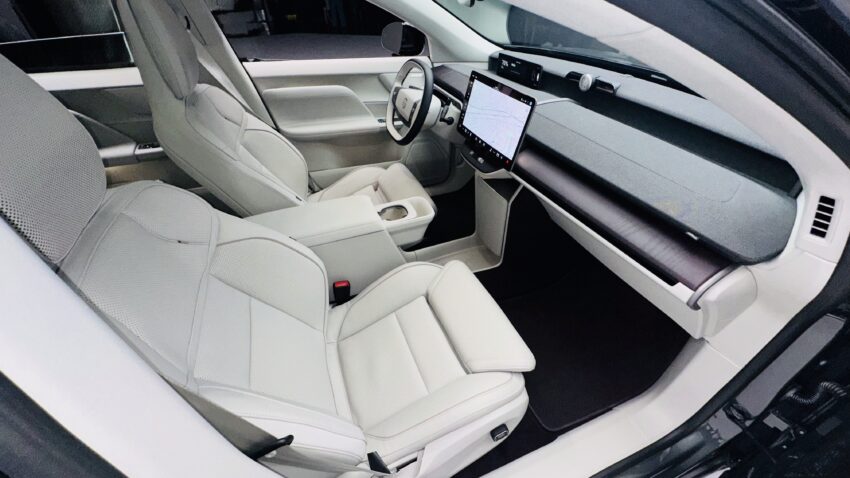
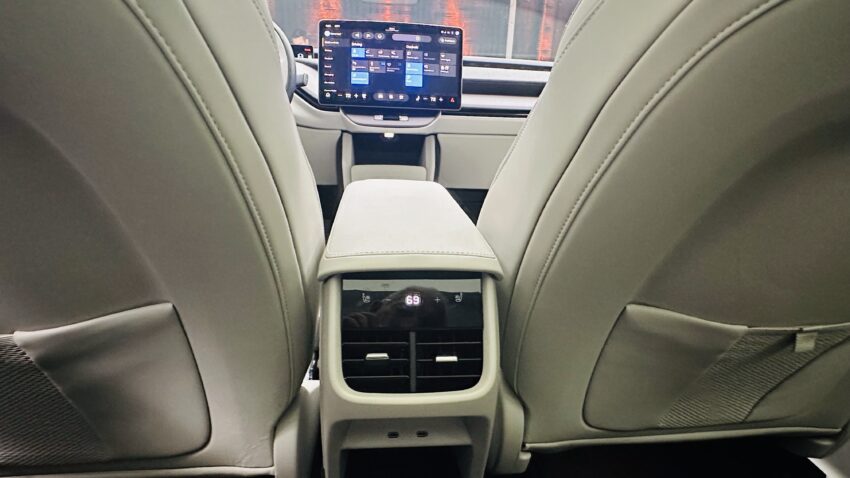
The EX60’s interior is 100% Volvo EV – Scandinavian modern minimalism at its best, with slim, sporty-yet-supportive seats (Nappa leather in the Ultra trims, some type of synthetic in others, we expect), a covered center console with a largish open bin at floor level, a 15-inch OLED infotainment touchscreen dead center and a long, narrow, rectangular digital driver information screen mounted atop the dash and behind the smallish, flat-bottomed steering wheel.
Volvo hasn’t yet provided details about interior fittings, but we expect lots of goodies such as ambient lighting, wireless phone charging, multi-zone heating and cooling, head-up display, heated seats (there was even mention of heated integral child booster seats in one trim), soft-touch surfaces on door and dash panels, and a variety of dash trims (the preproduction Ultra trim we saw had a muted wood-grain panel stretching across the bottom of the dash ).
We do know that a Bose 21-speaker audio system is standard equipment, with a 28-speaker Bowers & Wilkins system available in the Ultra trims.
Cargo, Towing
Volvo says that the EV60’s cargo hold – the area behind the second row seats – can store up to 20.4 cubic feet of cargo – that’s 20 standard grocery bags or about 6 standard airline carry-ons stacked to the top of the seat backs. Fold the 60-40 split rear seats down and total cargo area grows to 58.2 cubic feet.
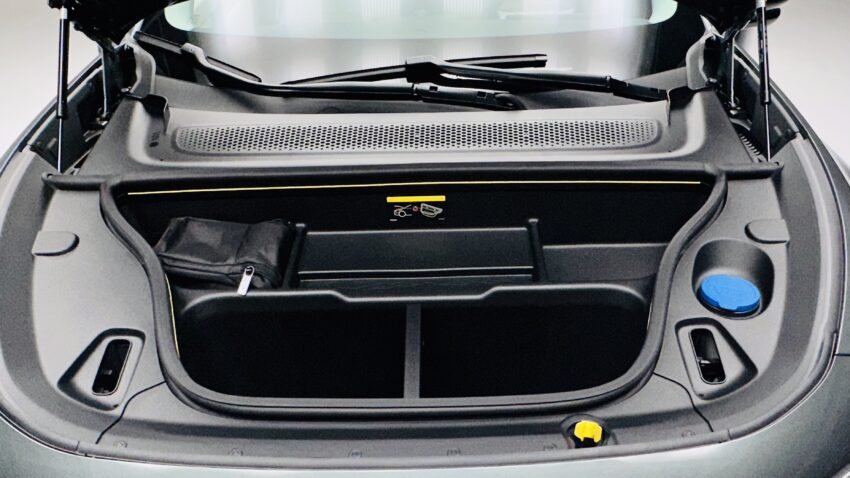

There;’s also a 3-cubic foot front trunk – or frunk (above, left) – and a deep, carpeted, 2.2-cu. ft. well under the cargo bay floor (right). Oddly, Volvo doesn’t include the underfloor compartment in its measurement for the primary cargo bay.
Additionally, the P10 and P12 versions are rated to tow a maximum of 4,500 pounds; the P6 a maximum of 3,600 lbs. That’s more than the current model year’s gas version can haul.