

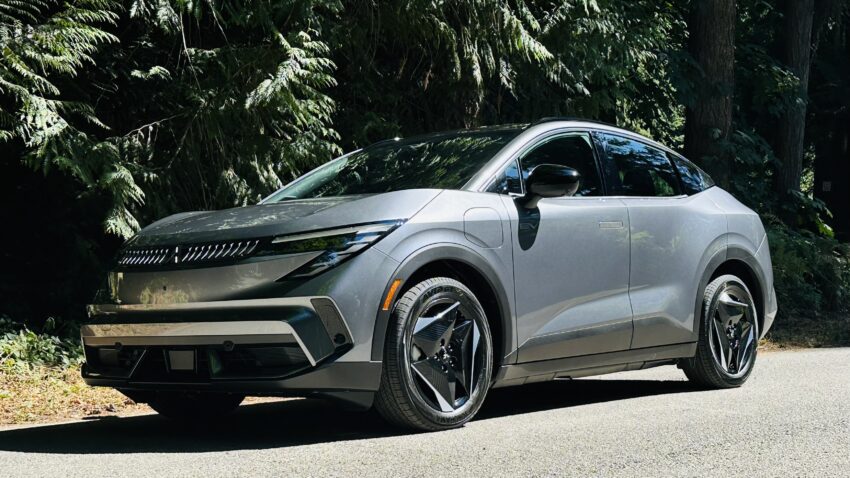
It’s rebuilding time for Mitsubishi, which is turning to a major stakeholder – Nissan – for help. The 2027 Eclipse Sportback, Mitsubishi’s first EV in a decade, will be a re-badged and face-lifted Nissan Leaf.
That’s not a bad thing. The third-generation Leaf, introduced for the 2026 model year – is a solid performer that gets good marks in most categories. It’s not top-of-the-heap, but its base and mid trims deliver lots of range and offer plenty of features at value pricing
Mitsubishi is a partner in the Renault-Nissan-Mitsubishi Alliance and sharing the Leaf, sans those exterior pieces and interior trim bits that turn it into the Eclipse Sportback – saves Mitsubishi a bunch on engineering and development costs while boosting Nissan’s income.
For Mitsubishi, a lot will depend on how the corporate marketing mavens decide to price their version – which slots between the mid- and upper trims in the Leaf lineup -and how much they’re willing to spend promoting it.
We recently had the opportunity to spend a few hours with the 2027 Mitsubishi Eclipse Sportback as part of a day-long Mitsubishi powertrain program (we also sampled the revamped plug-in hybrid system and new mild hybrid system for the 2026 Mitsubishi Outlander, those reviews coming later).
We weren’t gobsmacked, but this isn’t intended to be that sort of vehicle.
It’s not a Tesla-fighter, packed with more power and new tech than any sensible person could want. It is certainly not related to its namesake, the Eclipse sports coupe (1990-2012). And while it shares the Eclipse name it has little else in common with the the internal combustion Eclipse Cross compact SUV (2017-present). But we were happy with what Mitsubishi is bringing to the table with the Eclipse Sportback – a slightly better-looking version of the Leaf.
Why Now?
Mitsubishi wants to grow and in a market dominated by players such as Ford, GM, Honda and Toyota (we did that alphabetically so as not to offend anyone) a small company grows first by exploiting niches in the market.
For Mitsubishi, this includes the EV market which, despite way too many reports to the contrary, isn’t dying. It’s just slowed, thanks to the loss of federal support, the resulting decision by a lot of the big EV makers to pull back on production, and the industry’s concentration on high-priced models.
Right now, EVs account for about 5% of the new-car market in the U.S. That’s down from a peak of 10% in 2024, when the federal government still thought they were worth promoting with incentives.
The seers at Bloomberg NEF (New Energy Finance), however, recently posited that EVs’ U.S. market share could grow to as much as 26% by 2030 even without federal assistance. That’s well below the 48% everyone was projected a few years ago, but it is still growth and Mitsubishi figures it can bring some new customers into the fold if it offers a competitive electric vehicle. Its last one was the tiny 66-horsepower i-MiEV city car – just 62 miles of range – that was sold in the U.S. from 2012 through 2017 and in Japan form 2009 through 2021.
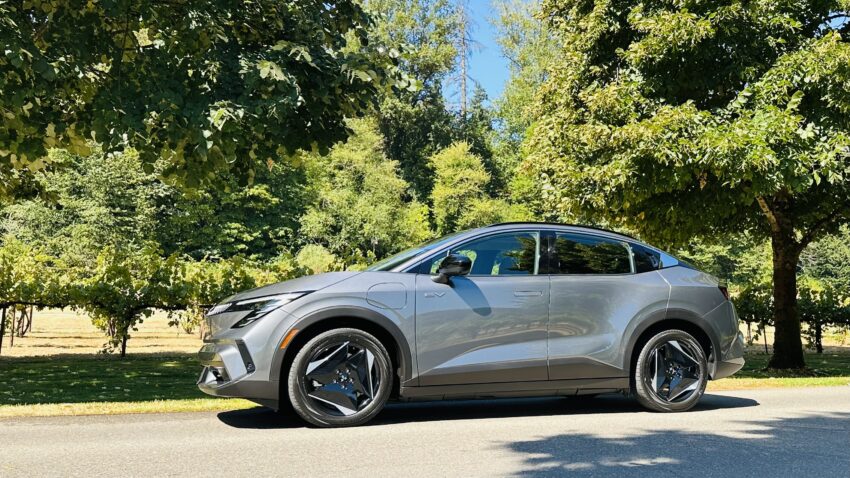
After years of disappointing U.S. sales – down to about 100,000 nationally in 2025 from a peak of almost 355,000 in 2002, Mitsubishi wants to regrow its presence, especially in the west, where EVs still sell. (It also has plans for a small pickup and a resurrected Montero SUV, both apparently to be gas-burners. Of its almost 300 U.S. dealerships (Nissan has more than 1,000) just 17 are in California, which is EV central for the nation and was Mitsubishi Motors North America’s home base until it relocated to Tennessee in 2019. The company has just three dealers in Washington, another EV-friendly state, while Oregon has only 2 Mitsubishi dealers, both in the Portland area.
Mitsubishi sees opportunity for EV sales in ongoing high gas prices and a growing desire for economical transportation as the Covid era fades and more and more people – willingly or not – give up work-from-home and return to the office for at least several days each week.
The hope is that a non-nonsense small but sporty-looking EV with good range, decent performance, a comfortable ride, car-like proportions and some SUV utility – a 20-cubic foot cargo bay and roof rails, for instance, along with a better warranty than its Nissan Leaf counterpart – could be just the ticket.
The Lineup
There’s only one trim level and one add-on package for the Eclipse Sportback (versus four trims and several packages for the Nissan Leaf).
Pricing hasn’t been announced but is expected soon as the Eclipse Sportback is supposed to start rolling into dealerships by early October.
What’s different about the Eclipse Sportback?
Mechanically, the Eclipse Sportback is identical to the Nissan Leaf, they share the same platform including suspension, powertrain and battery.
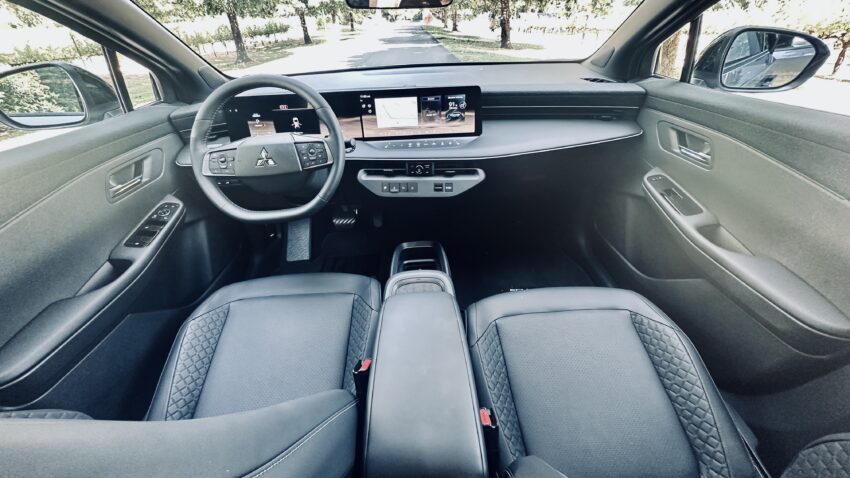
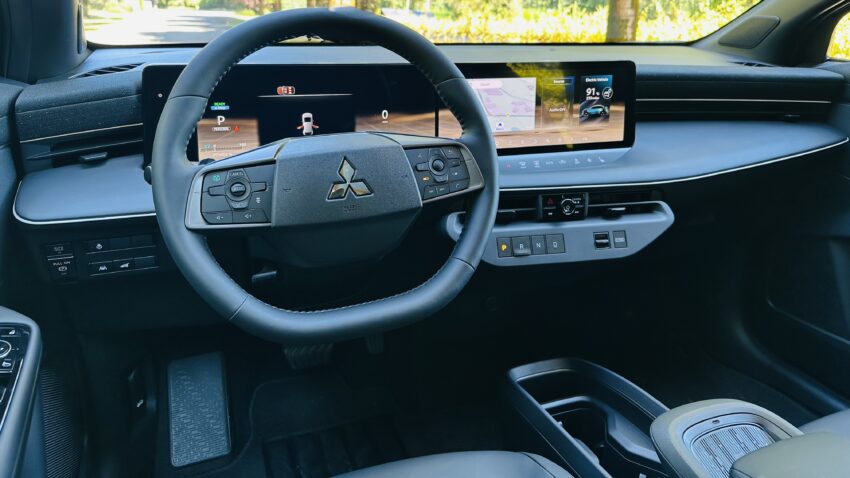
The interiors have identical fittings but the Eclipse Sportback uses different colors and textures for upholstery and dash and door coverings and has its own colors and layouts for the digital driver info and infotainment screens. There’s also a Mitsubishi logo instead of a Nissan badge on the square-bottom steering wheel.
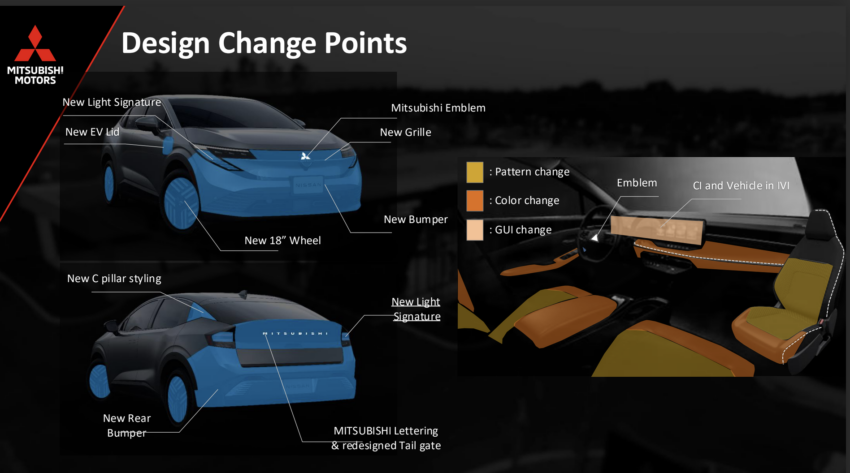
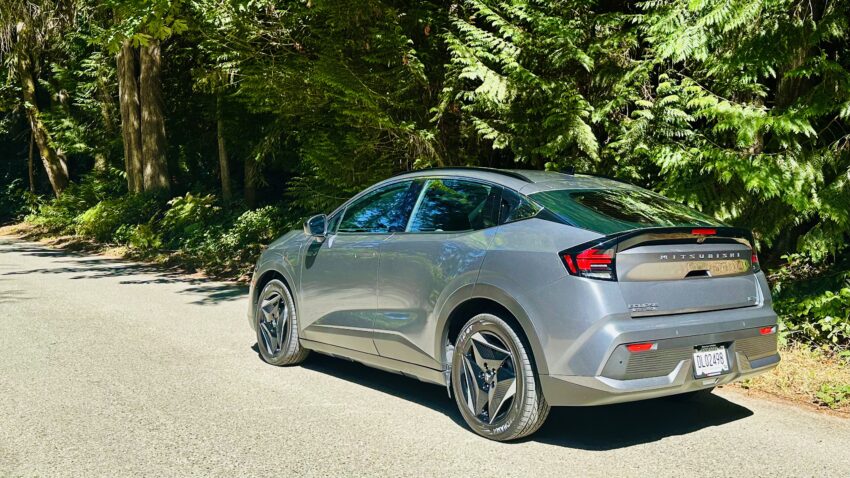
Key external differences are what make the Eclipse Sportback stand apart from Nissan’s Leaf and include a new front bumper and LED headlamp design and a distinctly Mitsubishi grille. The rear bumper and taillight design is also new, as is the shape of the C-pillar and the diamond-shaped design of the alloy wheel centers (Mitsubishi’s logo is the triple-diamond badge). All the badging is Mitsubishi as well, of course.
Beefier Warranty
For many shoppers, the most important difference might be Mitsubishi’s warranty package, which offers longer periods of protection for most critical components than does Nissan’s.
Mitsubishi’s package includes 10-year/100,000-mile powertrain and battery coverage, versus five years/60,000 miles for Nissan’s. Both have eight-year/100,000 limited warranties for battery capacity . But Mitsubishi provides a five-year/60,000-mile new vehicle limited warranty, versus three years/36,000 miles for Nissan, and seven-year/100,000-mile anti-corrosion coverage, versus Nissan’s five years but unlimited miles. Mitsubishi also does better with roadside assistance – five years and unlimited mileage versus three years/36,000 miles for Nissan.
Nissan’s free scheduled maintenance package tops Mitsubisi’s, though, at three years/36,000 miles versus Mitsubishi’s two-year/30,000-mile program. Both cover in-cabin air filter changes, tire rotation and general inspections, but Nissan’s plan also covers a brake fluid change (there’s not much else to cover in an EV – no oil changes, spark plugs or engine tuneups).
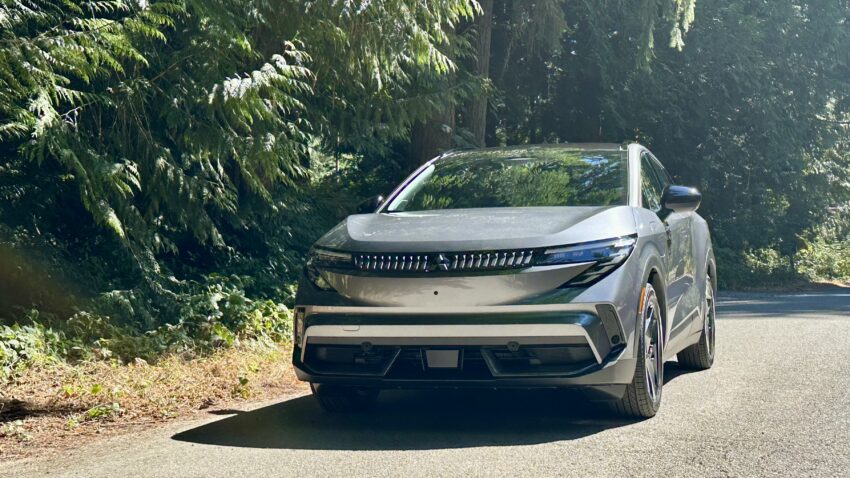
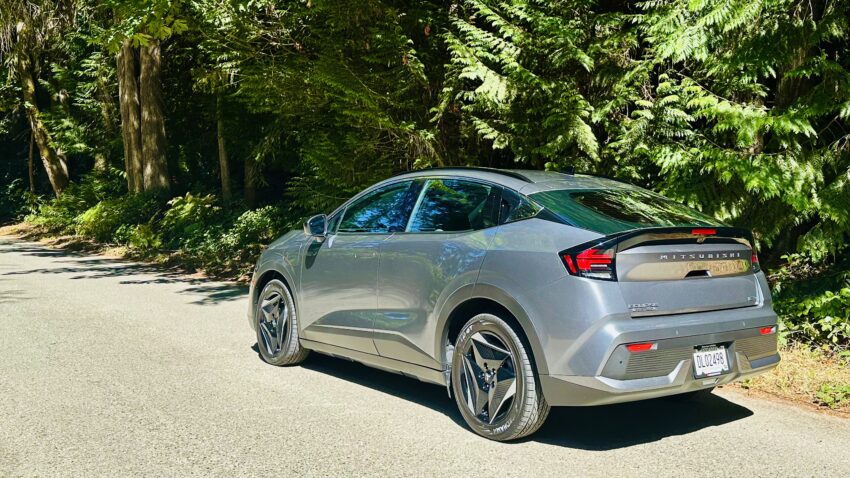
Mitsubishi hopes visual changes to the Eclipse Sportback (above) such as the new grllle, wheels, tail end and lighting signatures will make it more attractive to shoppers than the Leaf (below), which was redesigned for 2026.


The Sportback’s liquid-cooled, 75 kilowatt-hour lithium-ion battery (nickel-manganese-cobalt chemistry) can deliver an EPA-estimated 282 miles of range when fully charged. That’s slightly below the 288 mile rating for the mid-trim Leaf SV+ but well above the 259-mile rating for the top-trim Leaf Platinum+ with 19-inch wheels. The range difference likely is due to weight and aerodynamic changes.
We’ve found that the Leaf sticks pretty close to its EPA estimated and it’s not too difficult for a light-footed driver to exceed the numbers. We didn’t get sufficient time in the Eclipse Sportback to predict how close to its EPA estimate it will hew, but given its Leaf powertrain, it should do pretty well.
Charging specifications and numbers are identical for both models: each as a Tesla-style NACS port on the passenger-side front fender for DC fast charging and a J1772 port on the driver-side front fender for Level 1 and Level 2. Mitsubishi supplies a L1-L2 charging cord that works with both 120- and 240-volt outlets and a CCS to NACS converter that enables the Eclipse Sportback to use almost any DC fast-charge station available (except the rare-and-getting-rarer CHAdeMO chargers that pre-2026 Leafsand all Mitsubishi Outback PHEVs need).
The Eclipse Sportback’s battery can be fully charged when starting fully depleted in about 12 hours on the type of Level 2 (240-volt) charging equipment typically used for home and workplace charging. For road trips or when a quicker charge is needed than you can get at home, the Sportback can charge at a maximum of 150 kW at DC stations and needs about 35 minutes to bring the battery’s state of charge to 80% when starting at 10%.
What You Get
The base Sportback – (we expect pricing to be somewhere between the Leaf SV+’s $35,775 and the Leaf Platinum+’s $40,535) – comes pretty well-loaded.
Standard equipment includes 18-inch alloys wheels and all-season tires; LED lighting; keyless entry and ignition; faux leather upholstery with quilted bolster panels; textured textile dash and door panel coverings; power adjustable and heated side mirrors; a pair of 14.3-inch horizontally-oriented digital information screens with color displays – one for the driver and one for the infotainment system; heated front and rear seats and a heated steering wheel; an 8-way powered driver seat; wireless phone charger; wireless Apple CarPlay and Android Auto compatibility; a surround-view camera and monitor; a six-speaker audio system; Google-powered navigation with trip planning including charger locating and charging time estimates; and a full suite of active and passive safety and driver assistance systems including front and rear automatic emergency braking with front collision and rear cross traffic warnings
Mitsubishi supplies the Eclipse Sportback with a portable charging cable capable of both Level 1 (110-120 volt) and Level 2 (220-240 volt) charging, plus a CCS to NACS converter for DC fast charging to enable use of both types of DC fast charging stations.
There’s also vehicle to load (V2L) capability that allows the EV battery to be used to power small electrical devices such as an outdoor camping lantern or hotplate, an e-bike charger, small power tools and some household appliances in the event of a short-term power outage. The Sportback is equipped with a pair of 120-volt outlets – one in the cargo area and one at the rear of the center consoleand owners can also separately purchase an adapter that plugs into the J1772 chargigng port.
For those who want a bit more, there’s a Tech Package – cost not yet available – that adds a panoramic roof with electrochromic glass that dims on demand (just push a button) and is heat regulating as well. No internal shade is needed. The package also includes a 10-speaker Bose premium audio system; a hands-free rear liftgate, and roof rails designed to be compatible with the glass roof.
The Eclipse Sportback will be available in five exterior colors, but only one – “Storm Grey” – comes as standard at no charge. The others – tones of red, white, black and blue – will be available at an additional cost, not yet released.
We haven’t received information yet about other content or accessories.
How’s it Drive?
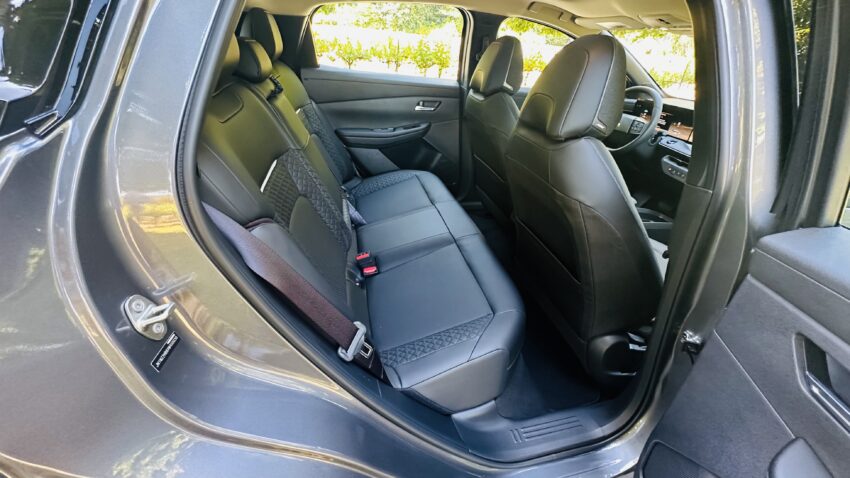
It’s a Leaf. It rides well and is comfortable and peppy. There’s lots of headroom in both rows and plenty of legroom up front, but passengers with long legs might start feeling a bit cramped in the rear seats after a few hours.
Despite the “Sport” part of its name, the Eclipse Sportback isn’t a sports car, nor is it a drag racer. It holds its own on gently curving country roads, but can lose some grip and start exhibiting body roll when asked to aggressively attack a set of twisties.
There are three pre-set driving modes – Eco, which preserves battery charge by tamping down energy drains including accelerator response and air conditioner performance; Standard, which is , well, standard, and Sport, which firms up steering a bit and provides for quicker accelerator pedal response and firmer brake pedal. A fourth mode – Personal – allows the driver to mix features from the other modes. You can, for instance, have Eco accelerator response, Sport steering and Level 3 regenerative braking, if you want.
Sport is the best setting for curvy roads – in flat or mountain terrain – and for drivers who have a crushing need to be among the first across any intersection and the quickest around any corners. It will cost a few miles of range, however.
In any mode, acceleration is more tempered than in many EVs, when slamming the accelerator pedal to the floor at start will almost guarantee a neck-snapping rush. The Eclipse Sportback instead starts rolling smartly and gradually builds speed. It can do a zero-to-60 mph sprint in about 7 seconds, which is mid-pack for small EVs but more than enough to get you safely onto a fast-flowing freeway. And there’s plenty of acceleration for passing and hill climbing.
The suspension is biased toward comfort and with its standard 18-inch wheels the Sportback delivers a very nice ride, even of fairly rough roads. (In contrast, Nissan’s top Leaf trim, the Platinum+, comes with 19-inch wheels and the tires’ narrow and stiffer sidewalls can make for a pretty bumpy trip on washboardy or potholed roads and on gravel and other rougher surfaces.)
We found the interior to be very quiet at low and moderate speeds – we didn’t get past 70 on the roads available to us during our drive in the heavily wooded but mostly suburban Woodinville area in Washington’s winery country about 30 miles northeast of Seattle.
The Eclipse Sportback’s brakes can feel a bit soft and the regenerative braking system, which offers four levels, is almost-but-not-quite a one-pedal system. In its most aggressive level – 4 – it will quickly slow the Sportback to about 6 mpg, but then you have to use the brake pedal to come to a complete halt. Mitsubishi calls it the e-Pedal and it is actuated by a dash-mounted switch. The regen levels, can be toggled through with paddles on the steering wheel.
Cargo and Storage
The Sportback isn’t overly endowed with space in the passenger compartment to cram stuff , but there’s enough. The covered storage well in the center console is deep but not very big overall, and is augmented by an open storage bin on the floor where a transmission hump would be in an ICE. There’s also a small box in the lower center of the dash, a traditional passenger-side glove box and pockets on the backs of the front seats, narrow map pockets in the doors, a pair of cup holders in the center console – which also has a drop-in compartment for wireless phone charging – and two more cup holders in a flip-down center divider in the 40/60 split rear seats.
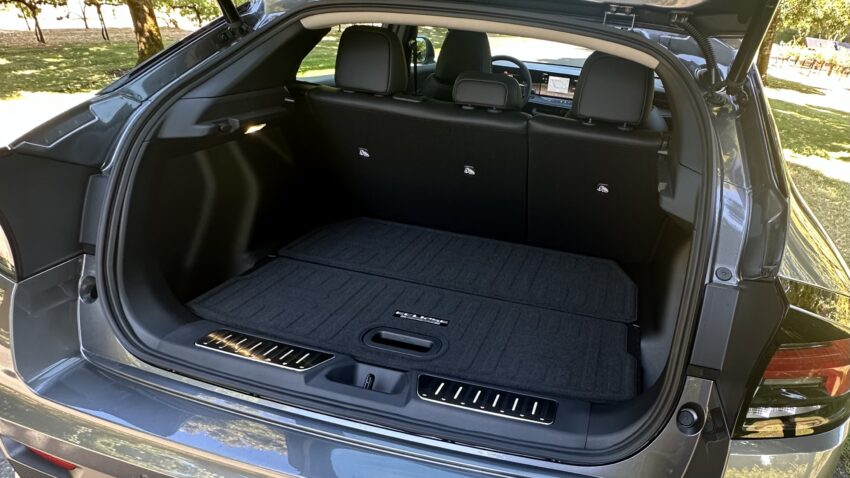
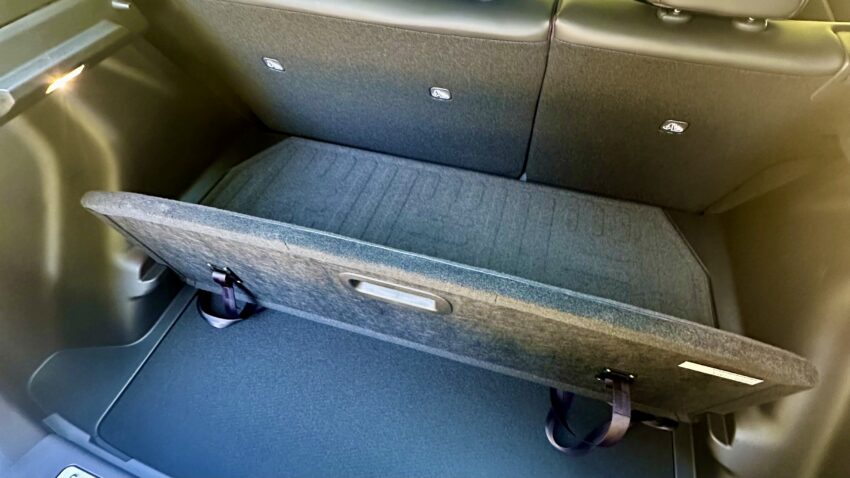
Behind those rear seats there’s room for a couple of suitcases in the 20-cubic-foot cargo hold, and you can probably squeeze in a bicycle, lying on its side, in the 55 cubic feet you get when lowering the rear seat backs. The “flip-and-fold” cargo bay floor can be reconfigured to divide into two compartments to help keep smaller items from rolling around and grocery bags from spilling their contents. The charging cord and adapters are stored under the cargo floor.
The Sportback is not rated for towing. Aftermarket hitches that can be used for bicycle carriers and such are available for the Nissan Leaf, though, and should also fit the Mitsubishi.