

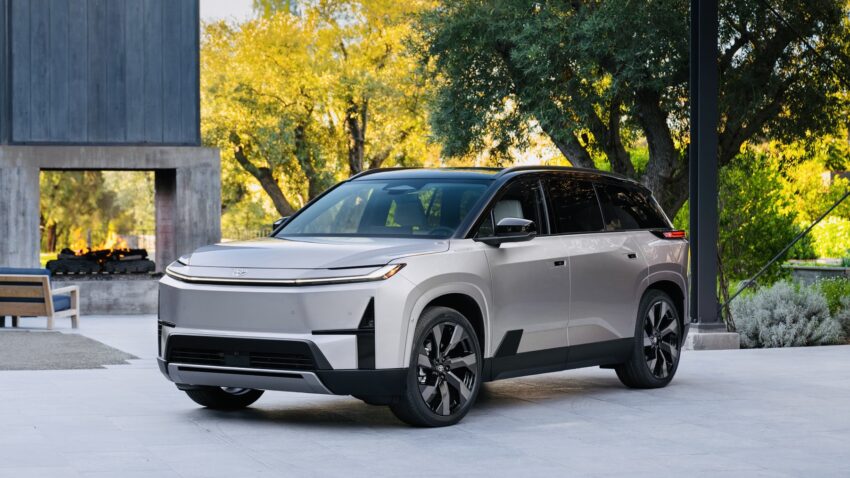
Toyota’s aging Highlander will get new life with a new look and new propulsion system as the all-electric, three-row, 2027 Highlander crossover.
[Updated 2/13/26 with on-sale timing and towing and vehicle-to-home power information.]
On paper, the new Highlander EV looks great; testament to the company’s ability to make decent EVs however cautiously it approaches the task.
We’ll have to wait to get inside and behind the wheel to experience it as nature intended to answer questions like: can anyone sit comfortably during a trip in those third-row seats? Does the power-on-paper translate to decent performance on the road? How’s the real-word range, and is the price reasonable?
The biggest question, of course, is how will it measure up in real life to competitors such as the highly praised Hyundai Ioniq 9 and its corporate cousin, Kia’s EV9. The dry specifications put them all relatively close – a little more horsepower or torque for one, a slightly smaller cargo bay for another – but until we get into a 2027 Highlander – closer to its on-sale date, expected to be early 2027 – we can’t pass judgment.
And while most who are looking seriously at an electric three-row probably aren’t terribly interested in an ICE, the electric Highlander’s still going to have to compare well to internal combustion models such as the Honda Pilot, Mazda CX-90, the Hyundai Palisade and Kia Telluride cousins and Toyota’s own Grand Highlander.
One thing we don’t like is that a number of functions including plug-and-pay charging and automatic battery preconditioning require multi-year subscriptions at an extra cost. But like it or not, subscription services is the way the industry is going as cars become more computer-like and Toyota’s certainly not the only automaker doing it.
“EV” isn’t part of the 2027 Highlander’s official designation because starting with the fifth-generation 2027 model all Highlanders will be electrics. The internal combustion Highlander, now ending its fourth generation after almost 26 years in the Toyota lineup, will be a thing of the past with the larger Grand Highlander, introduced as a 2024 model, taking its place.
The electric Highlander will be Toyota’s first three-row EV and either its third or fourth battery-electric vehicle in the U.S. market, depending on how you count them.
(Check out our 2027 Highlander photo gallery)
Built in the U.S.A.
It will be built at Toyota’s assembly plant in Kentucky, with batteries that were assembled at its newly opened battery plant in North Carolina and is the first Toyota EV built in the U.S.
Preceding it are the bZ crossover and about-to-launch C- HR small crossover, which makes three EVs including the upcoming Highlander. There’s also a beefed-up version of the bZ called the bZ Woodland that Toyota counts as a separate model, enabling it to claim four Toyota EVs in its U.S. lineup for 2027.
Pundits can argue over whether the decision to launch the 2027 Highlander shows conviction on Toyota’s part that EVs really are an important part of the future or is simply an effort to recoup development costs on a model that was well underway when the Trump Administration upended the market by pulling federal support for EVs.
Whatever the reason, and whether the 2027 Highlander EV is No. 3 or No. 4 in Toyota’s electric vehicle lineup, it’s a welcome addition to a segment that shrunk a bit this year with VW’s decision to yank the ID.Buzz from the U.S. for 2026, Tesla’s announcement that it will stop building the Model X (a different price category, but still a 3-row EV) and Honda’s decision to stop developing a planned three-row EV in the wake of losses it has sustained in a softening U.S. market for electric vehicles.

Power, range and cargo capacity
But enough of that. Here’s a look at the top features of the upcoming 2027 Toyota Highlander. Key things such as price, interior measurements and official EPA-estimated range and overall efficiency figures aren’t yet available – we’ll update as they are:
Toyota’s own range estimates are pretty good – from 270 to 320 miles depending on trim and battery size.
There will be two trims, the XLE and Limited.
The XLE will be available with front-wheel drive or all-wheel drive. The Limited has all-wheel drive only.
Power: All AWD trims will have motors front and rear with combined output of 338 horsepower and 323 lb.-ft. of torque. The front-drive XLE gets a single motor with 221 hp and 198 lb.-ft. of torque. All-wheel drive comes with multi-terrain selection and crawl control modes.
Batteries: There will be two battery sizes: 77 kilowatt-hours is standard for the front- and all-wheel drive XLEs with an optional 95.8-kWh pack for the XLE AWD. The 95.8-kwH pack is standard for the Limited
Charging: Home charging on 240-volt (Level 2) equipment as fast as 11 kW per hour; DC fast charging maximum power is not yet specified, but probably around 250 kW as Toyota says recharging from 10% to 80% of capacity would take 30 minutes in optimal conditions. A Tesla-style NACS (North American Charging System) charging port is standard, and each Highlander will come with a dual-voltage 120-240 (Level 1 and 2) portable charging cord for home and opportunity charging.
Toyota says all versions of the 2027 Highlander will have vehicle-to-load capability – requiring one or more accessories – so the on-board battery can be used to power external devices, such as power tools, or to provide backup power “in case of an emergency.” The company hasn’t published hard numbers, but a Toyota product specialist told thegreencarguy.com that it can provide sufficient backup power to run a whole house. Just how long it can keep the power supplied is info that’s yet to come.
Range: Toyota’s range estimates, which we expect are very close to what the official numbers will be, are 270 miles for the XLE with all-wheel drive, 287 miles for the front-drive XLE and 320 miles for the Limited and the large battery AWD versions of the XLE.
Cargo volume: 15.9 cubic feet behind the third-row seats and 45.6 cubic feet with the third-row seating folded down.
Towing: The competition can tow small trailers, personal watercraft and the like, and Toyota told us the Highlander will be able to tow as well. But its maximum load rating hasn’t yet been determined.
Standard features
XLE
- 11 kW on-board (Level 1 and 2) charger
- 19-inch alloys
- 14-inch infotainment screen with Toyota Audio Multimedia
- Wireless Apple CarPlay and Android Auto compatibility
- 12.3-inch digital driver information screen with real-time navigation display
- 6-speaker audio
- Paddle shifters to set regenerative braking level
- One-touch second-row fold system for easier third-row access
- Fold-flat third-row seats
- Heated front seats and steering wheel
- Hands-free, powered rear liftgate
- Separate climate system controls for rear seating (2nd and 3rd rows) area
- Toyota Safety Sense 4.0 with radar-based dynamic cruise control, lane-keeping assist, lane departure alert with corrective steering assist, and front collision warning and mitigation with pedestrian and cyclist (bike and motor) recognition.
- USB-C charging ports in all three rows
- Dual Qi wireless phone charging tray in front console
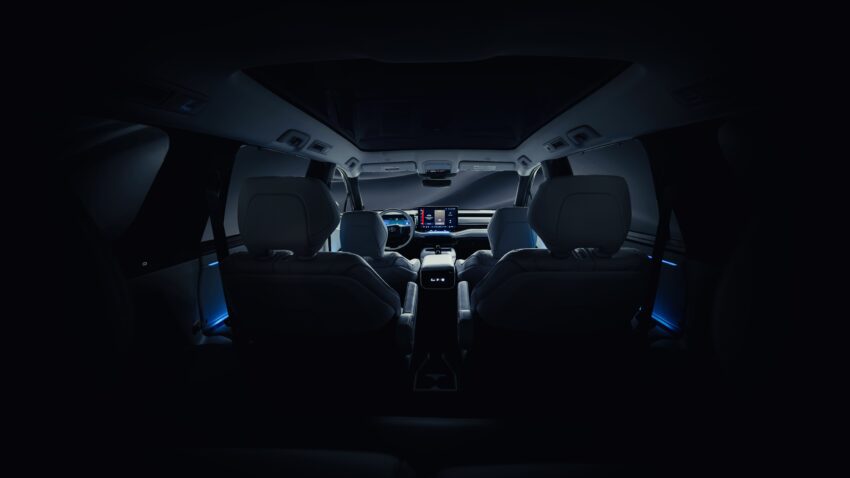
- Customizable ambient lighting
Limited
- Everything on the XLE, plus:
- Head-up display
- Position memory and tilt-while-reversing features for side-view mirrors
- Ventilated front seats
- Heated second-row seats
- Advanced parking assist, traffic jam assist (requires a subscription), lane change assist, front cross-traffic alert
Options:
- Second-row Bench seating for XLE with all-wheel drive
- 11-speaker JBL Premium Audio for Limited and all-wheel drive XLE
- Panoramic roof for all trims
- Two-tone paint for Limited
- 22-inch wheels for Limited
- Bi-directional power system
A little comparison
The 2027 Highlander EV will be built on a modified “K” or mid- and full-size vehicle version of Toyota’s next-generation architecture – the TNGA-K platform, for short. The platform allows for underfloor installation of the battery pack and and uses front and rear underfloor covers and deflectors to increase efficiency with improved airflow and reduced turbulence.
The Hyundai and Kia 3-row competitors use a jointly developed (both companies are owned by Hyundai Motor Group and collaborate on many under-the-skin components) EV-specific platform that has the same kind of aerodynamic tweaks and underfloor battery fitment. It’s called the E-GMP or Electric Global Modular Platform.
The redesigned Highlander body lowers the roof line by eight-tenths of an inch but adds 2.3 inches of width .Overall length hasn’t been provided but and a 120.1-inch wheelbase is 8.1 inches longer than the outgoing model’s, pushing the wheels closer to the corners and opening up additional interior space.
The Ioniq 9 and EV9 have slightly longer wheelbases, a higher roofline and roughly the same width as the Toyota.
They Hyundai is a six-seater while both the Kia and the Highlander can be configured in select trims as seven-seaters.
The Highlander has more horsepower than either the Ioniq 9 or EV9 in the base rear-drive format (221 hp vs 215 hp). With all-wheel drive, the Toyota has more power than the Hyundai – 338 vs 303 hp – but less than the EV9 AWD ‘s 379 hp. The Ioniq 9’s three upper trims rated at 422 horsepower and 516 lb.-ft. of torque.
The Ioniq 9 has a bigger battery and slightly more range across the board than the 2027 Highlander EV, ranging from 311 miles to 335 miles depending on trim. The EV9 has slightly less range in its upper trims than the Toyota (304 miles vs 320) but the same 270 miles in its base trim.
Both of the Korean competitors have more cargo space behind the third row than does the Highlander, but cargo capacity with the third row folded away is almost the same for all three.
The two Korean EVs are rated in the U.S. for towing up to 3,500 pounds with rear-drive and 5,000 pounds with all-wheel drive. Toyota hasn’t yet disclosed the Highlander’s tow ratings.
The Ioniq 9 and EV9 claim slightly faster 10%-80% DC charging rates than the Highlander – 24 minutes vs 30 minutes.
We can’t compare pricing, interior comfort and utility or driving characteristics yet, but we’ll be back as more specifications are disclosed and as soon as we can get behind the wheel in all three.