

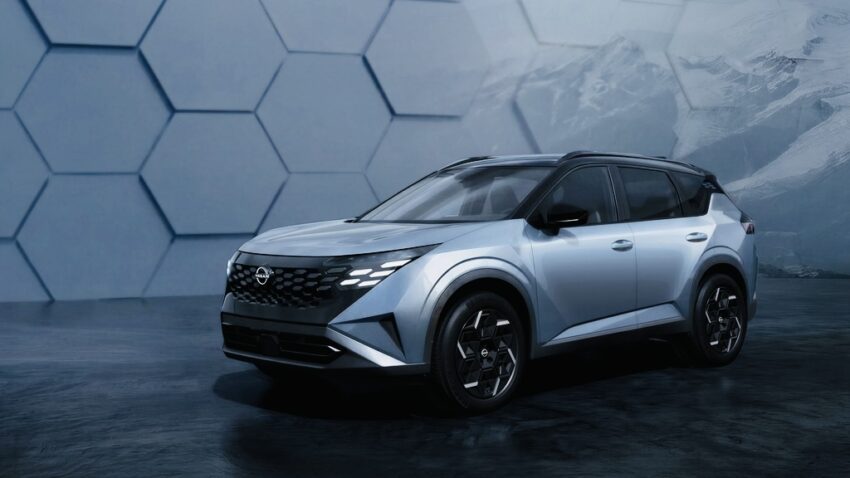
Don’t call it a range-extended EV, even though the redesigned 2027 Nissan Rogue Hybrid uses a small gasoline engine to power a pair of electric motors that do the actual work. Nope, it’s a series hybrid, and it will be the only one being sold in the U.S. when it debuts later this year.
Nissan unveiled the new Rogue at an event in Japan earlier this week, saying that while a gas-only version of the popular compact crossover would be coming, it’s the 2027 Rogue Hybrid that will kick things off when sales begin late this summer.
Its turbocharged, 1.5-liter, three-cylinder engine isn’t connected to the wheels in any fashion, and there’s no plug.
The new Rogue Hybrid’s smallish battery (probably somewhere in the 2- to 4-kWh range, final figures haven’t been released) – is charged from regenerative braking energy and with power generated by the engine. The battery stores and releases energy from the generator as needed by the standard all-wheel drive system’s two electric motors. When prolonged demand depletes the battery charge, power from the engine-generator will flow directly to the motors.
A quick hybrid lesson
Conventional hybrids such as the Prius are known as parallel hybrids because their systems are designed so the gas engine and electric motors can work independently or in unison. Sometimes a parallel hybrid is running only on gas engine power. Sometimes – usually briefly and at low speeds – it is all-electric, and sometimes it is getting power simultaneously from its engine and its electric motor, or motors.
The 2027 Rogue Hybrid, though, will run solely on electricity – like an EV – but will draw power for the motors from a three-cylinder gas engine that runs as a generator. The two work in series – thus the name series hybrid – with power from the engine flowing to the Rogue Hybrid’s two electric motors (one for each axle), which then turn the wheels to make it go.
The Nissan difference
Nissan calls it the e-Power hybrid system and introduced it in Japan way back in 2016. It later introduced a couple of e-Power hybrids in Europe, but the the 2027 Rogue Hybrid marks the first time e-Power has made it to the U.S. It also marks the introduction of the third generation e-Power system.
While Nissan has other 1.5-liter, 3-cylinder turbocharged engines in its lineup,including one used with the second-generation e-Power hybrids, the third-generation engine has its own block, cylinder head and intake and exhaust manifolds, Christian Spencer, a senior manager at Nissan Technical Center North America, told us in a recent interview.
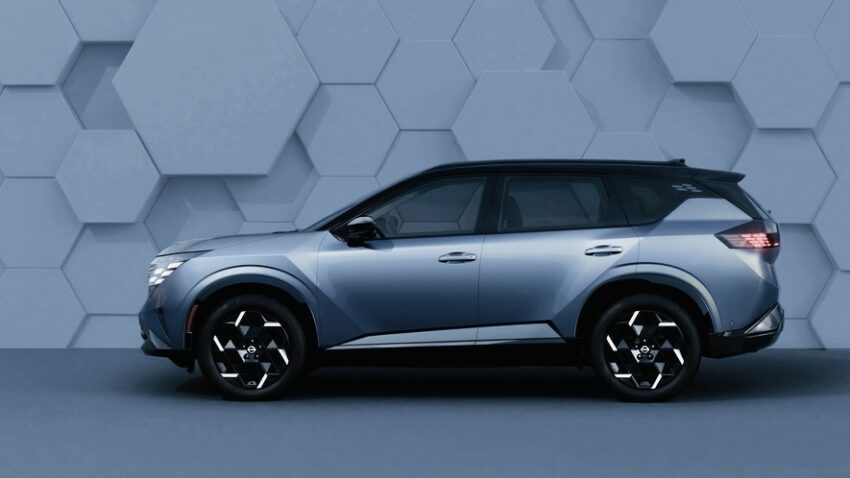
The e-Power engine, designed to work solely as a generator, also loses the variable combustion capabilities of the i.5-liter in the non-hybrid Rogue, and even has a different sized turbocharger.
All that is because it doesn’t need to work the same as in an ICE-powered vehicle, which needs the gas engine to provide enough oomph to get things rolling before it settles back into a more relaxed mode while cruising.
The e-Power system does all this with electric motors.
Spencer said that even though it still relies on a gas engine to generate the power its electric motors need, the new Rogue Hybrid has the driving characteristics of an EV. Several reviewers invited to try a pre-production prototype in Japan earlier this year (we were not among them) generally agree, although there were several who commented that initial acceleration isn’t as instantaneously zippy as in an EV.
There have been hybrids in the past that operated in series fashion most of the time, but each had a quirk that made it into something else. The Chevrolet Bolt, for instance, linked the engine-generator directly to the wheels for short periods to improve efficiency. The BMW i3 REX and the Fisker Karma didn’t have mechanical links between engine and wheels, but did have large battery packs that needed to be recharged from the power grid for maximum efficiency. Their engine-generators kicked in when the battery charge fell below a predetermined level.
About that series disconnect
Drivers of those now-defunct quasi series hybrids will recall that there was a disconcerting disconnect between what the driver was doing with the accelerator pedal and what the engine was doing to meet the vehicle’s power demands.
Because the vehicles’ engine-generators were feeding juice to a battery, they didn’t need to work very hard when the battery was full – even if the driver’s right foot was mashed to the floor attempting to overtake a semi on a steep uphill grade. Conversely, if the battery was near empty, the engine-generator could be racing while the vehicle was sitting at a red light.
That still happens with Nissan’s e-Power system, Spencer told us. But because the engine-generator was designed for the system, not adapted to work with it, and because Nissan did a great job with sound dampening, the engine noise is barely discernible, regardless of speed.
That claim, too, has been upheld by reviewers who got a short stint behind the wheel of the prototype in Japan.
One-pedal, too
The third-gen e-Power system gets another EV-like touch – Nissan’s E-Pedal system for one-pedal driving. Turn it on and the regenerative braking system does into heavy-duty mode, and is capable of bringing the Rogue Hybrid to a full stop without use of the brake pedal. Previous generations of the e-Power system didn’t have that feature.
When e-Pedal mode isn’t engaged (and we always wonder why not?), the 2027 Rogue Hybrid’s regenerative braking power is used for something called “Smooth Stop.” Spencer said it modulates the stopping force to eliminate pulsing and smooth out the last bit of the braking process.
All the rest
Nissan hasn’t said much beyond the powerplant info about the 2027 Rogue Hybrid.
It is expected to start in the low $30,000s – which is where the 2026 non-hybrid Rogue starts. Although still a compact, five-seat crossover, it it is a bit larger that the current Rogue. Those who’ve had an early peek said it is wider, with a roomier cabin. It also is expected to get an EV-like 14.3-inch infotainment touchscreen that likely will be the control and information center for most vehicle functions.
There should be several trim levels so those who want to spring for more accoutrements can get glass roofs, heated – and cooled – seats, upgraded audio systems and the like.
Beyond that, there have been hints at a 15% fuel efficiency improvement over the non-hybrid, which would put it in 37 -40 mpg territory.
If so, it won’t be nearly as efficient as a pure battery-electric vehicle but will be up there with the likes of the Honda CR-V (37 mpg overall) and Toyota RAV-4 (42 mpg overall) hybrids, but with the added benefit of that EV-like driving experience the competition can’t offer.
You’ll still have to buy gasoline, though.
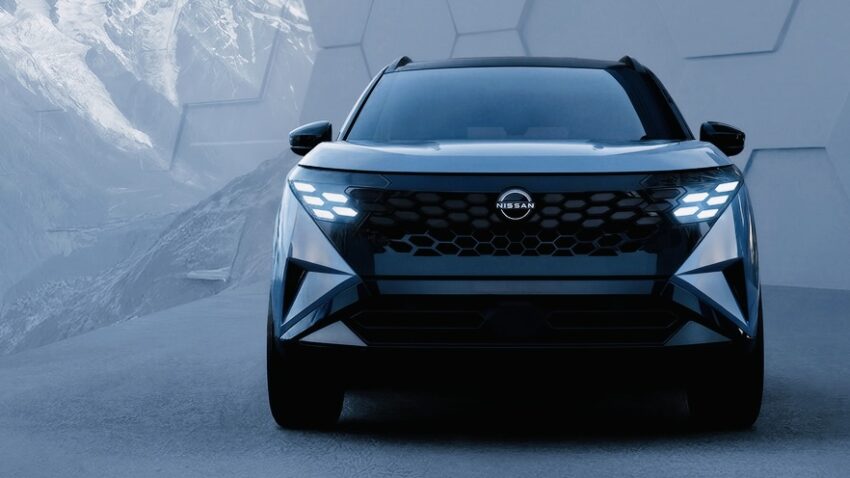
Nissan photo