

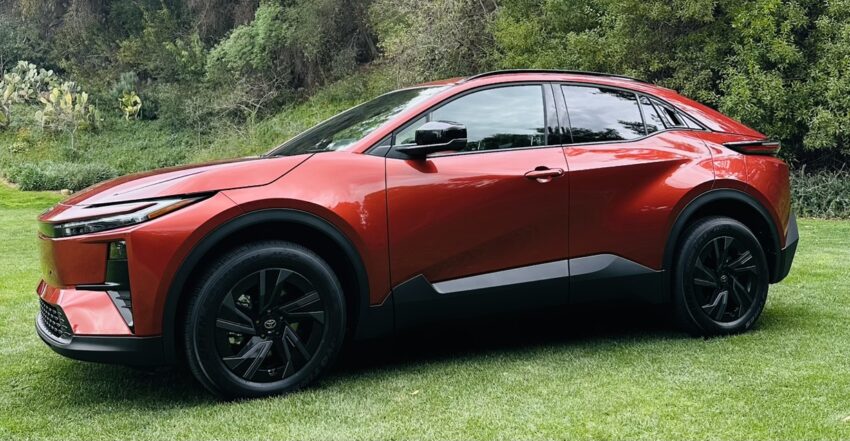
By biding its time, Toyota is entering the EV market in the U.S. just as competitors are backing out. The all new 2026 C-HR, which revives a nameplate that was retired in 2022, will be the company’s second or third EV here – depending on launch timing – when it hits dealer showrooms in March.
While Mercedes-Benz, with eight models, and General Motors with seven across four brands at last count are leaders, Toyota soon will be tied with BMW and Hyundai with four all-electric models each for the U.S.
If the 2026 CH-R beats the 2026 bZ Woodland to showrooms it will be the second Toyota EV in the market here – behind the standard bZ crossover introduced last year. If the Woodland, also slated to go on sale in March, hits first, then the C-HR will be the third. Toyota, long accused of hating EVs, will add its fourth for the U.S., the 3-row Highlander EV, early next year.
The 2026 C-HR is a powerful entry in the compact crossover EV category, with sporty crossover-coupe styling,loads of features and a dual-motor, 338-horsepower, electronic all-wheel drive powerplant. It doesn’t hit the 300-miles range mark that pundits say American EV buyers insist on, but the 2026 C-HR comes close at 287 miles for the base SE trim and 273 miles for the more upscale XSE.
While its styling echoes that of the original, internal combustion C-HR, there’s little else that remains. That original got by with a 144-horsepower four banger, for instance, and was front-drive only. It wasn’t outfitted nearly as nicely and was priced in the mid-$20,000s to attract first-time new car buyers.
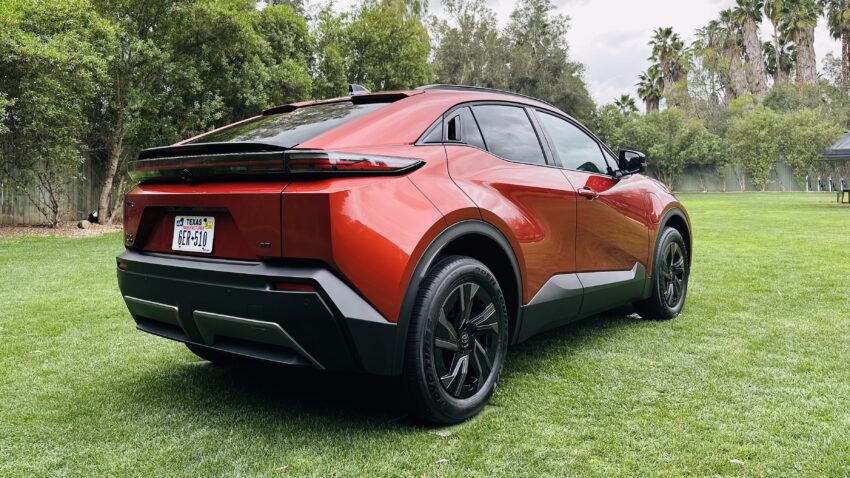
All that changers with the resurrected, all-electric C-HR, which now offers a larger cabin, more cargo capacity, loads more power, a sporty-but-comfortable ride and driver assistance features that were only just coming into play when the original was in its heyday. The new C-HR also loses a styling cues like the frowning front end and deeply creased rear haunches that made it easy to apply descriptors like “funky” and “slightly odd looking” to the old one.
C-HR, btw, stands for Compact High Rider, or else Cross Hatch Run-about (although it’s not really a hatchback anymore) or even Coupe High Rider. It all depends on who you ask.
Behind the wheel
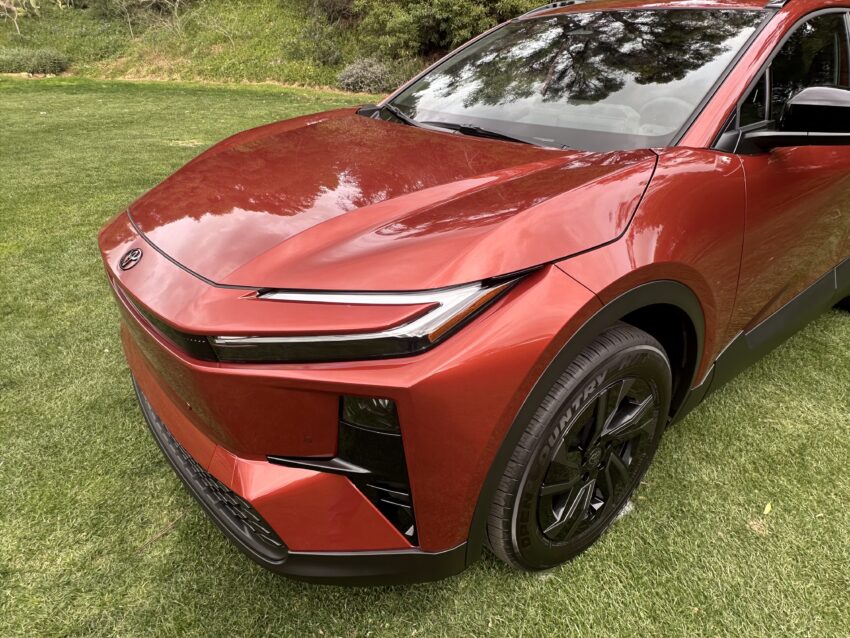
Toyota recently introduced the C-HR to reviewers at a multi-model event (the company’s two other new EVs co-starred) held in the artsy Caliofrnia town of Ojai , We had a few hours behind the wheel on an overcast day following a night of sometimes heavy rain that slicked the roads in the Topatopa Mountains surrounding the Ojai Valley and caused more than a few mild rock tumbles and mud splashes from mountainside to roadbed.
The 2026 Toyota C-HR’s electronic all-wheel drive handled it all with aplomb, keeping a firm grip even when pushed hard thrrough curves scattered with small ricks and mud. It’s the same system used in other Toyota EVs with AWD, but without the Subaru-developed X-Mode for off-road driving.
Although the new C-HR has a relatively high stance – 8 inches of ground clearance – it is decidedly not set up for off-roading and will be marketed instead as an “urban commuter.”
That stance makes it easy to get in and out of the vehicle and to load and unload cargo through its rear power liftgate.
Although sporty, the 2026 C-HR is not a sports car and doesn’t drive po handle like one, but it has plenty of power for passing, climbing hills, entering freeways safely and – in urban California at least – breaking the freeway speed limits those rare times of day when traffic isn’t at a near-standstill.
In our drive time with the XSE trim with 20-inch wheels and all-season tires, we found it to be pleasant to drive. Steering wasn’t terribly responsive but it wasn’t sloppy and kept the nose going where it was pointed. Braking was almost effortless as the C-HR has four levels of regenerative braking, the stiffest of which will slow the car to a 2 mph crawl without help from the mechanical brakes. Well-timed switching through the “regen” levels, controlled by paddles on the steering wheel, served almost like a transmission to help manage speed on curvy roads.
The new C-HR is fairly quiet inside and the seats are both comfortable and supportive. The suspension is stiff enough that potholes and bumps in the road could be felt, but not to the point of discomfort. We expect the 18-inch tires on the SE trim, with their taller sidewalls, would provide a slightly softer ride.
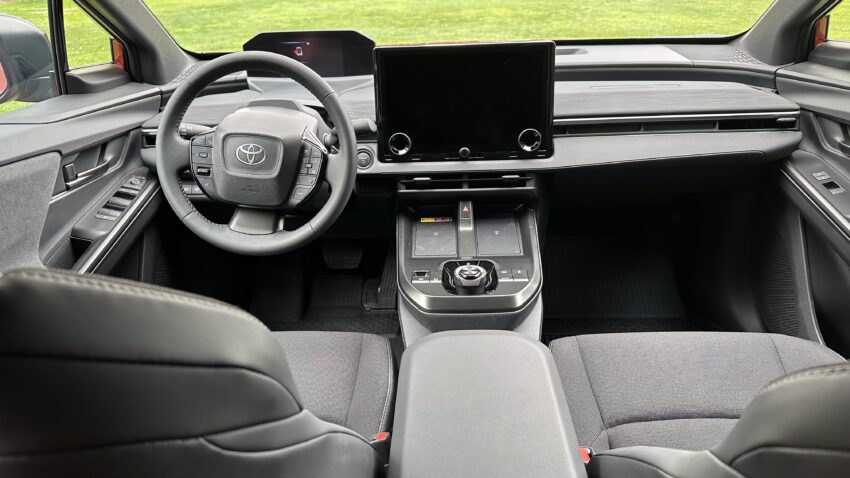
There’s little not to like, but as has been the case with the bZ and bZ Woodland, we found placement of the C-HR’s 7-inch, dash-top mounted driver info screen awkward, the middle of display usually blocked by the steering wheel. We’re also not fans of Toyota’s refusal to provide a rue one-pedal regenerative braking mode that allows drivers who practice the timing to coast to a full stop at red lights and stop signs without touching the brake pedal.
For an urban daily driver, though, the 2026 Toyota C-HR does the job quite well and ticks a great many boxes. It’s a small-but-roomy EV that’s worth and urban runabout shopper’s consideration.
Now lets look at the nuts and bolts.
C-HR trims and pricing
Toyota has gotten pretty good at loading lots of features onto its cars and winnowing down the trim offerings to a relative few. Thus it is with the 2026 C-HR, which is available in just two trim levels, differentiated by additional appearance, comfort and driver assistance on the top trim.
The base SE starts at $38,450, including the mandatory $1,450 destination fee. The XSE starts at $41,900 with options that can add a few thousand to the out-the-door cost.
Powertrain
Both trim levels have the same powertrain – and they share it with all but the base trim of the larger bZ crossover. It’s a dual-motor electronic all-wheel drive system rated at 338 horsepower and almost that much torque.
(Toyota doesn’t provide a combined torque output for the dual motor system because it is rare that both motors are operating at full output. But for those who must have the raw numbers, the front motor is rated at 198 lb.-ft. of peak torque while the rear motor can deliver up to 125 lb.-ft.)
Toyota says it gives the C-HR a 0-60 mph sprint time of 4.9 seconds, which is plenty of power to merge onto a fast-flowing highway or pass a carbon-belching ICE on a steep hill.
Battery and charging
The C-HR comes with a 74.7 kWh battery and, as almost all new EVs are, has a Tesla-style NACS charging port. It comes with a NACS-CCS adapter for those times an older, non-Tesla fast charge station is all you can find. Also part of the standard equipmdent list is a dual voltage (120 and 240) portable charging cord for hok]me and oppportunity chakrging.
Toyota says a C-HR with a depleted battery can charge at home on properly sized Level 2 (240-volt) equipment in 7.5 hours, thanks to its 11 kW on-board charger., For trips, the C-HR can use up to 150 kW of DC charging power, sufficient in ideal conditions to bring a battery from 10% to 80% of capacity in 30 minutes.
Range
How far an EV can go is not only determined by its battery size, but by factors that include its weight and he size of its tires (bigger sizes generally have more rolling resistance, thus fewer miles).
The base Toyota C-HR comes with 18-inch wheels and all-seas tires and is rated at 287 miles of range; the slightly heavier XSE has 20-inch wheels and all-season ties and loses 14 miles of range for an EPA-rated 273 miles.
Cargo
The C-HR provides decent cargo holding capability, with 25.3 cubic feet behind the rear seats and 59.5 cubic feet with the rear seats folded down. That’s about average for its class. To help visualize what you can cram in there, a standard grocery bag needs about one cubic foot while the average airline carry-on takes up about two cubic feet.
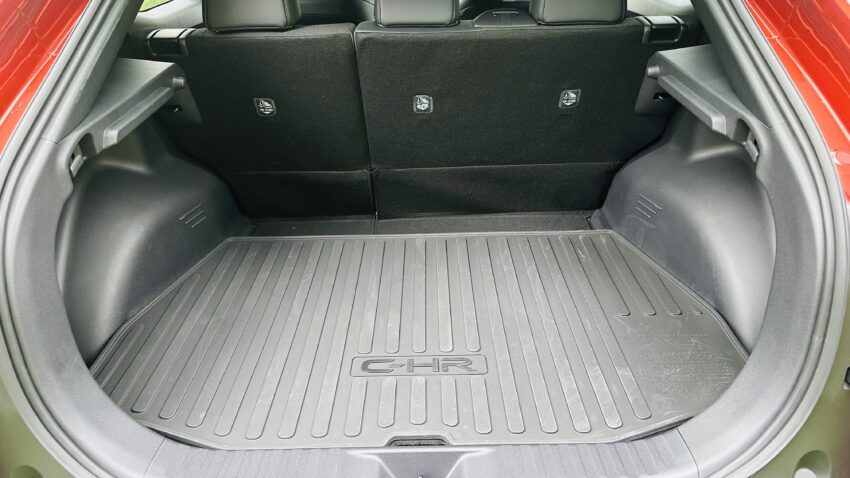
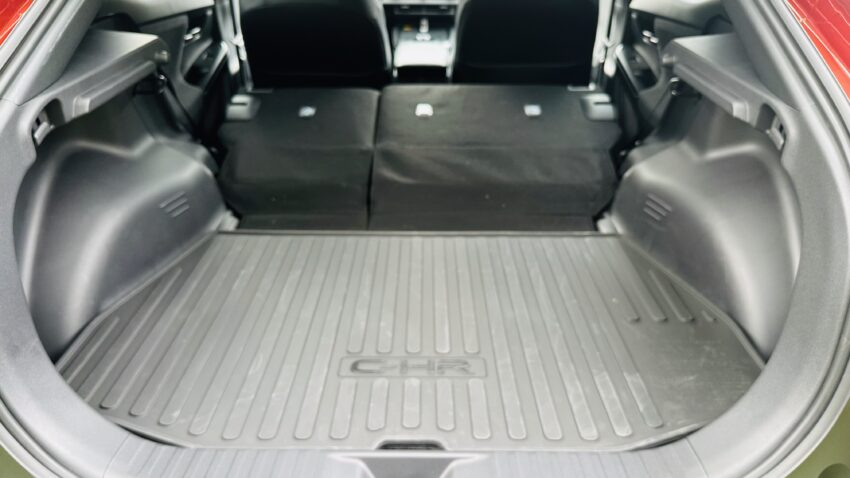
While not rated for towing, the C-HR does come with low-profile roof rails that can be fitted with cross bars and a variety of cargo and equipment carriers.
What else do you get?
Standard features on the base SE include:
- 18-in. alloy wheels with all-season tires
- LED exterior lighting
- Power liftgate
- Low profile roof rails
- 8-way power driver seat and 6-way manual passenger seat
- Heated front seats and steering wheel
- 60/40 split rear seats
- Interior ambient lighting
- 7-inch digital driver information screen
- 14-inch infotainment touchscreen with Toyota Audio Multimedia system
- Dual wireless Qi phone charging pads
- Four USB-Type C ports (one front media, one front 15W, two rear 60W combined)
- 12-volt auxiliary power outlet
- Front and rear parking assist with automatic braking
- Blind Spot Monitor
- Toyota Safety Sense 3.0 with full-range adaptive cruise control, front collision mitigation with pedestrian detection, lane following assist and lane departure warning with steering assist,
Stepping up to the XSE trim adds:
- 20-in. gunmetal-finished wheels
- side mirror puddle lights and position memory
- Synthetic suede-trimmed seats
- 8-way power passenger seat
- Auto-dimming rear view mirror with HomeLink
- Driver seat memory
- Traffic jam assist
- Lane change assist
- A panoramic-view monitor
Options, for the XSE only, include:
- A panoramic glass roof
- 9-speaker JBL audio system
- Heated rear seats
- Two-tone exterior paint
To facilitate this review, thegreencarguy attended a sponsored program with food, lodging and travel provided by Toyota.