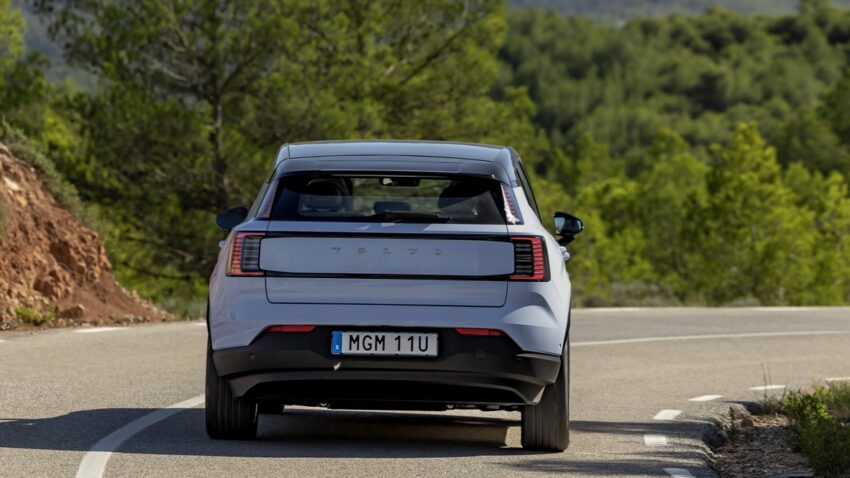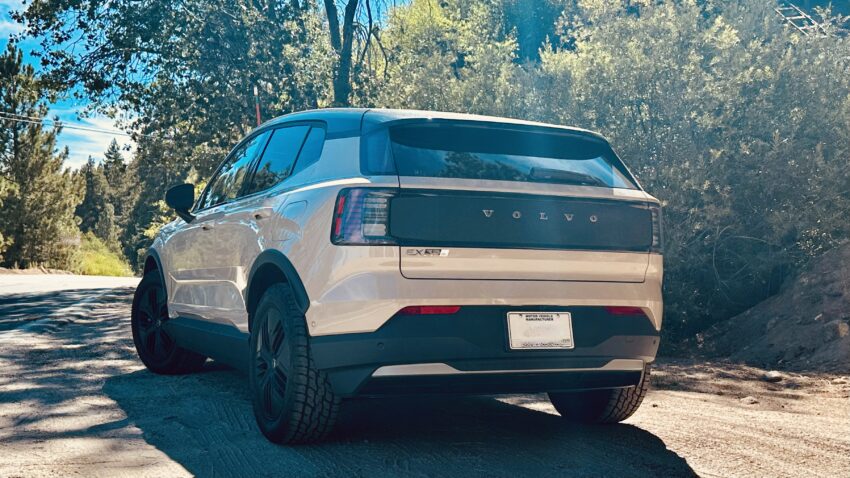
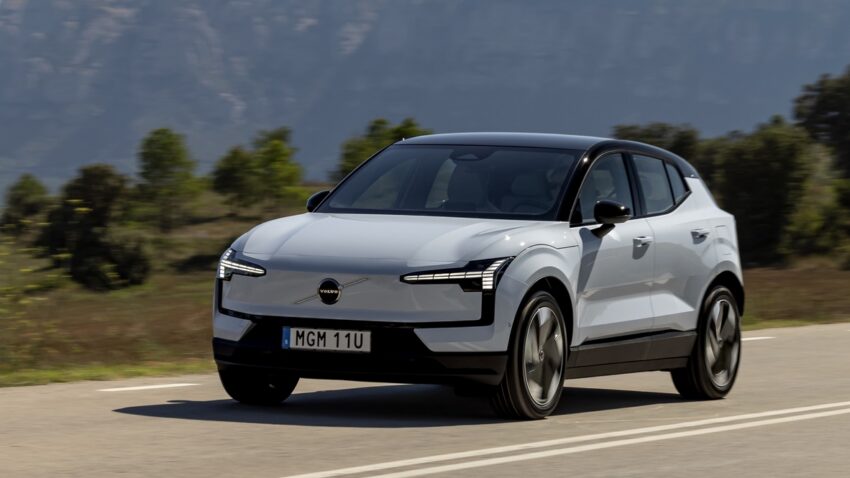
A European-spec EX30 Ultra./Volvo
Sometimes, the best time to look at a car is after it’s gone – dropped from the manufacturer’s new-model lineup but still available on the used car market, as will soon be the case with the Volvo EX30.
The little electric SUV, most versions ridiculously overpowered and a hoot to drive, was only introduced in 2025 but is being dropped from Volvo’s U.S. lineup for 2027 and beyond, thanks to the impacts of import tariffs and a weakened U.S. appetite for EVs following cancellation of the federal tax incentive on new electric vehicles.
Volvo’s also dropping the slightly larger and much pricier EX40 electric SUV from its US lineup, but not until the end of the 2027 model year when, depending on market conditions, low-mileage used EX40s might also become nice alternatives to new.
A larger new model, the Volvo EX50, is slated to replace both the EX30 and EX40 at the end of calendar 2027 or early in 2028. It is expected to start in the high $40,000s, which is where the EX30 upper trims start today.
Meantime, as the 2026 model year ends, Volvo no longer builds U.S.-specification EX30s. As of early October there were only about 1,000 new models left in dealership showrooms across the country.
That means most Volvo dealers are anxious to get rid of them and are open to bargaining. Volvo also is offering some regional and national discounts. So if new is for you and the EX30 fits your needs, you needn’t wait for a used one to show up, although waiting might be a good idea.
Not an orphan, maybe a good deal
Dropping the EX30 from its U.S. lineup doesn’t mean Volvo is orphaning it. Remaining new models and all used EX30s will still be covered by their warranties and still be serviceable at Volvo dealerships.
Parts will be available both because Volvo’s required to provide them while a vehicle’s warranty is in effect and, beyond that, because Volvo continues to build and sell the EX30 in other markets including Canada and Mexico.
When a model is discontinued by its manufacturer it generally drops in value on the used market, which could make EX30s a good deal as they start turning up in used listings.
A caveat is in order here – EVs, new or used – are in demand right now because gas prices are so high across the country, thanks to that war on Iran that keeps dragging on no matter how many times the White House says we’ve won it. That demand has stiffened pricing on all fuel-efficient vehicles, for now.
There aren’t many used EX30 on offer yet – the earliest models are only two years old – but Volvo has reported total U.S. sales of more than 7,000 EX30s for all of 2025 and through the first quarter of 2026 (it stopped providing sales numbers for individual EV models after that). Many were leased and early lease returns should start hitting the market in some volume in 2027.
As (if?) fuel prices settle down, a used EV30 could be just the ticket for someone seeking a well-equipped, safe, highly efficient and fun-to-drive vehicle.
We can say that with confidence after spending some time in a new EX30.
EX30 pros and cons
Before we head into detail territory, here’s a quick look at what we liked and didn’t about the EX30 we tested recently.
Thumbs up:
- It looks good
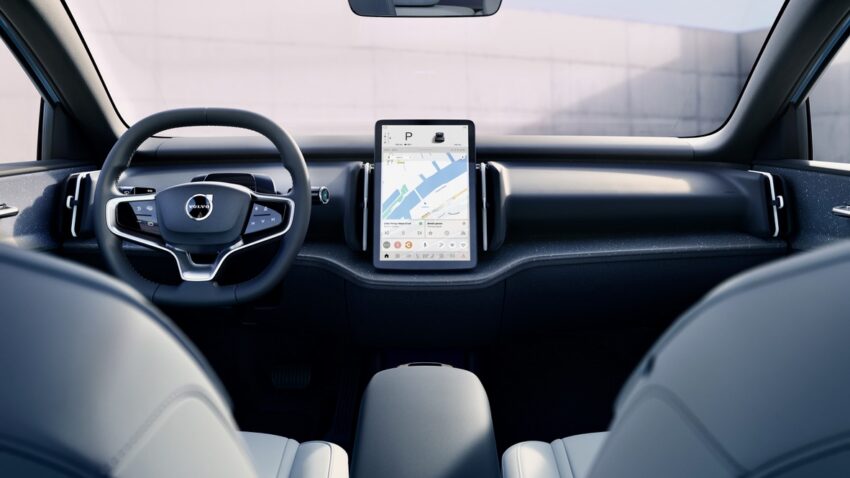
- Interior deign is Scandinavian modern-minimalist, clean and simple
- Seats are comfortable
- It is seriously quick
- Highly maneuverable
- Reasonably quick DC fast-charge times
- Base single-motor model pricing starts at just over $40,00, the lowest-priced Volvo available
- We got better fuel efficiency (more range per kilowatt-hour)than the offical EPA rating.
Thumbs down:
- Less range that many competitors
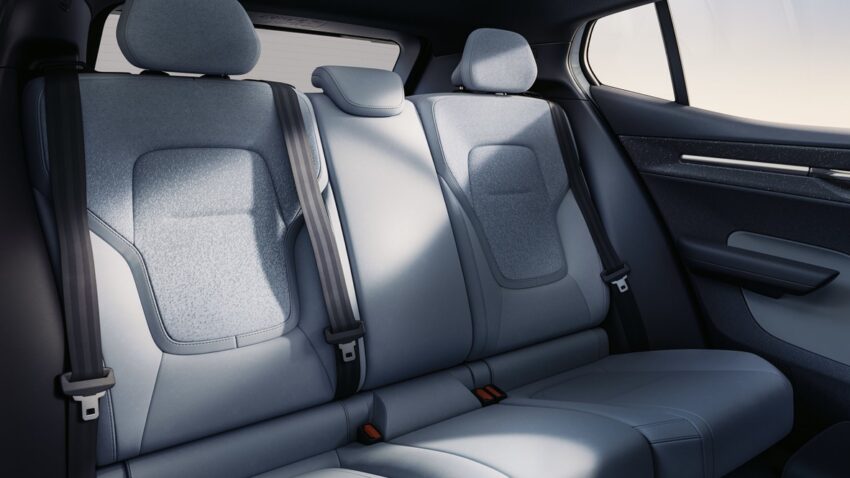
- Tight rear seating area
- Small cargo bay
- Too many controls buried in the central touch screen
- No separate driver information or head-up display
- Very annoying driver awareness alert system
- Ride can be stiff
- Upper trims and dual-motor versions can get quite pricey.
The EX30 driving experience
Volvo offered us a week in a 2026 EX30 Cross Country this summer, and although its U.S. demise had already been already been announced we took them up on the offer with an eye toward evaluating its potential for future EV shoppers in the used car market.
It is small, but it doesn’t have to be the family’s everything. It just has to be affordable and dependable enough to do the everyday stuff. That it looks good, is packed with features and advanced safety and driver assist systems and is a great driver’s car are added bonuses that can make a used EX30 (or a heavily discounted new model if there are any left when you go shopping) a quite sensible deal.
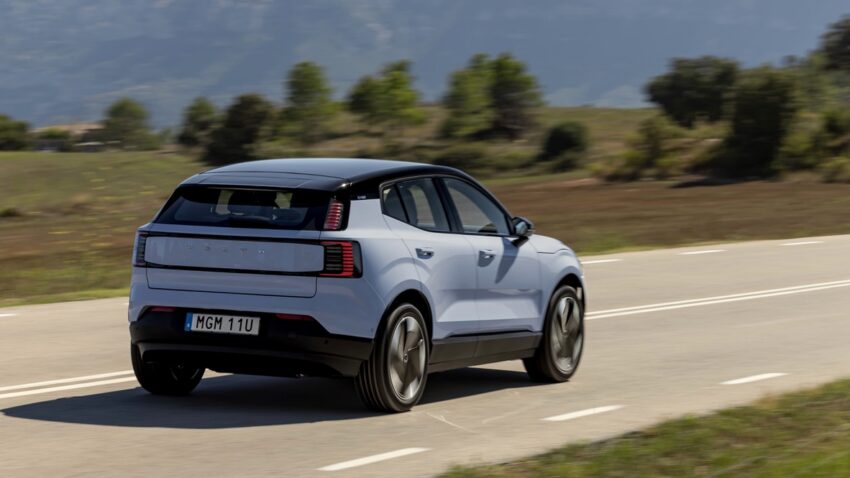
At about 167 inches long -almost 2 feet shorter than the EX60 – the EX30 is a subcompact. That makes it easy to park and easy to maneuver in city traffic.
Despite its size, Volvo managed to make the front section of the passenger compartment reasonably roomy although the back seat area is tight and cargo space is modest at best. But that’s fine in most cases for a second car intended for daily commuting and chore-running. Save the big SUV, pickup or – if you are one of the few who favor them – family sedan, for the vacation trips and for hauling more stuff than you can fit into the EX30, which, by the way, can tow up light loads.
EX30 models with the all-wheel drive, Twin-Motor Performance powertrain dominate the EX30 lineup for both 2025 and 2026 – and they are silly quick, rated at 422-horsepower and 420-lb.-ft. of torque.
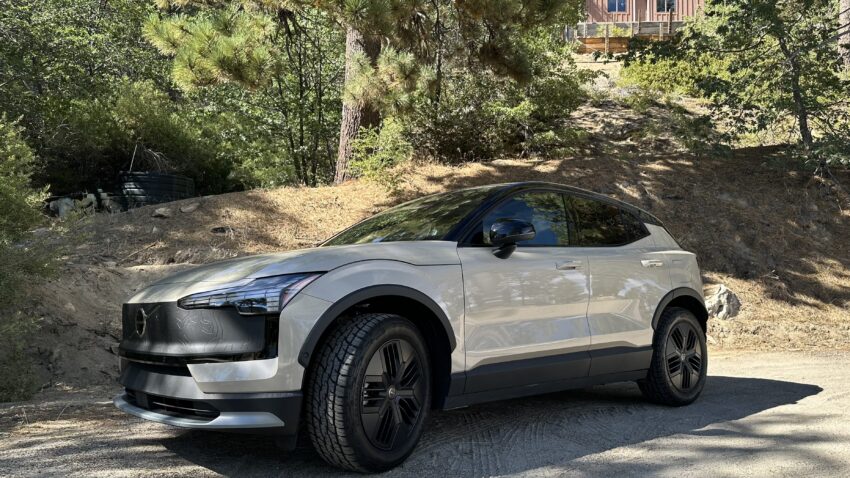
With its short wheelbase and near-zero overhangs, the two-motor EX30 darts around corners and through curves like a go-kart. It also can get a bit bouncy with the standard 19-inch wheels and all-season tires. We had the Cross Country’s optional 18″ wheels and all-terrain tires, which are pretty stiff, and while we definitely could feel the road beneath our seat, it wasn’t an uncomfortable ride. The Cross Country, though, has softer suspension settings than other EX30 models, and some reviewers have complained about the stiffness of the ride in those.
How quick?
Volvo claims the dual-motor EX30 can hit 60 mph from a standing start in 3.4 seconds. That’s a pretty honest assessment: Car and Driver magazine says it recorded a 3.3-second time, and Edmunds powered it down the test track at 3.5 seconds. That’s enough power easily let you merge onto a fast-flowing highway or to effortlessly pass big semis going uphill and it is certainly sufficient to get you in and out of the grocery store parking lot plenty quick (and can also get you a heck of a speeding ticket).
Single-motor trims, scarcer because most buyers chose the more powerful twin-motor setup, get a perfectly adequate 268 horsepower and 253 lb-ft of torque and are rear-wheel drive only. Edmunds recorded a 5.1-second time for a zero-60 mph run in one, which still is quicker than most competitive single-motor models.
The EX30’s chassis is nicely controlled, the steering is predictable and while it measures just under 14 feet from bumper to bumper, the car feels solid and there’s a sense of substance to the way the it goes down the road.
We tossed a twin-motor EX30 Cross Country through the curves and twisties on a jaunt in Southern California’s San Bernardino mountains around Big Bear Lake, a popular regional getaway. It demonstrated admirable driving manners, fuel economy and recharge-ability on the 202 miles of freeway and mountain driving it took to get there and back.
On the highway, the EX30 zipped smoothly along. There was plenty of power for passing and climbing uphill grades, and plenty of braking power. The cabin was very quiet, the seats comfortable. Volvo’s Pilot Assist system, which combines full stop-and-go adaptive cruise control, lane centering and automated lane changing assist, helped make driving long stetches of highway in moderate traffic a lot more relaxing than on trips made without the technology.
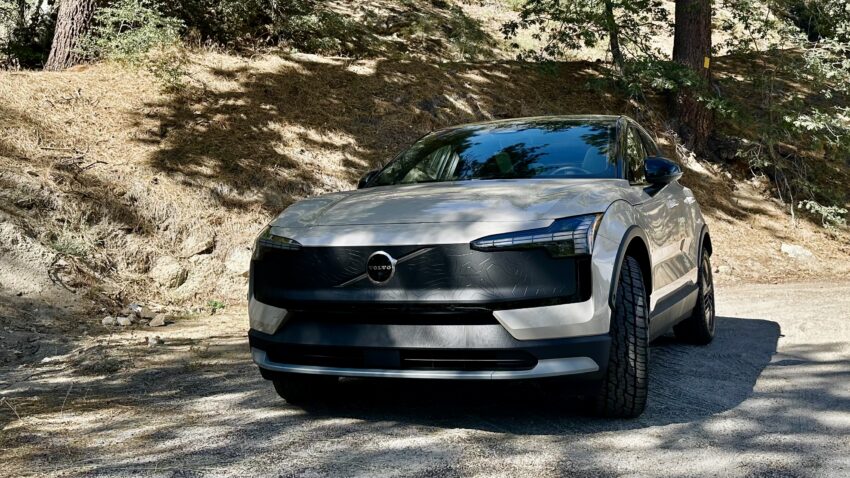
We always drive EVs with maximum regenerative braking to minimize use of the brake pedal. The EX30 has a programmable one-pedal setting that enables the driver to select low or high levels of regeneration. One pedal can be set in the vehicle controls section of the central touchscreen so it is always operating, but can also be toggled on an off and set at low or high levels using a customizable button on the steering wheel.
On twisty roads, one-pedal can work much like engine braking or downshifting. It allows the driver to slow the vehicle before entering a curve without using the mechanical brakes. Approaching stop signs and red lights, you can coast up to the stopping point and the powerful regenerative braking will bring the car to a complete halt with no need to mash the brake pedal (although quick stops do require brake pedal pressure). Once you get the hang of it, one-pedal is the only way to go.
The EX30’s steering is speed sensitive, firming up a bit as speed climbs, and drivers can pre-select “Soft” Normal” or “Firm” levels before beginning a trip. The operating software on 2025 models requires you to clicking through several menu layers on the central screen to changing steering settings – on the road that means pulling over and stopping. Volvo fixed that for the 2026 models, which have a permanently on-screen icon for changing steering input.
Overall, while we’re not fans of central touchscreen controls for everything and would prefer real knobs and buttons for the basics we found the EX30 to be thoroughly enjoyable on a longish trip. But that’s with just two two grown-ups. Don’t try this with four adults unless two are fairly compact in stature.
EX30 powertrains
We said most of this above, but to recap all in one place:
The EX30 was launched in the U.S. in December 2024 as a 2025 model with two all-wheel drive, twin-motor trims – Plus and Ultra.
For the 2926 model year, Volvo added a single-motor, rear-drive powertrain for the Plus and Ultra trims, as well as the twin-motor, AWD Cross Country Ultra, which it considers a separate model because of suspension and running gear tweaks and some Cross Country specific exterior molding and interior trim bits.
For both model years, EX30 dual motor versions have electronic all-wheel drive and a 268-hp motor on the rear axle augmented by a 164 hp motor on the front-axle for total system output of 422 hp and 400 lb.-ft. of torque.
The computer-controlled AWD system defaults to rear wheel drive in most normal conditions but can shift up to 37% of its power and torque to the front wheels when necessary – for quick acceleration or improved grip in slippery conditions, for instance.
There’s also a Performance mode – activated about three screens deep on the touchscreen or with one tap if you set up a touchscreen shortcut for it – that engages both motors full-time until the power is turned off (you’ve got to reset it each time you restart the car). Performance mode remaps accelerator pedal response for maximum aggression, turns on Creep mode and turns off one-pedal mode if you’ve got that set, and tightens steering and braking feel slightly.
For the single-motor versions introduced as 2026 models, there’s a single, 268-hp rear motor rated at 253 lb.-ft. of torque.
Battery, range, and official charging specs
All versions of the Volvo EX30 have a 69 kilowatt-hour battery pack rated at 64 kWh of usable power.
Single-motor version have an EPA-rated maximum range of 261 miles.
Twin-motor versions except the Cross country are rated at 253 mikes. The Cross Country. which is a bit heavier and a little less aerodynamic thanks to its higher ground clearance, drops to 227 miles with the standard 19″ tires and wheels and to just 203 miles with the grippier all-terrain tires on 18″ wheels.
Charging is relatively quick – both at home and one the road.
For home and opportunity charging, the EX30 is equipped for 11 kW Level 2 (240-volt) charging and, if your home charging is set up for that, can fully refill an empty battery in under 7 hours.
For DC fast charging while on the road, the EX30 is equipped with a CCS port but has an available adapter for NACS charging at Tesla Superchargers. It can take on juice at a maximum of 175 kw per hour, and Volvo says that in optimal conditions it takes just under half an hour to bring an EX30’s battery from 80% depleted back up to 80% of total capacity.
Charging in the real world
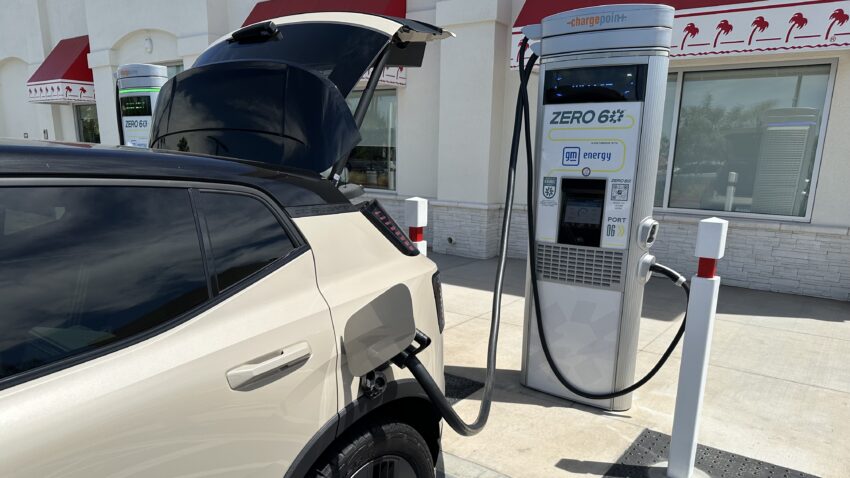
During our excursion in the EX30, we left home with a full battery and an indicated 204 miles of range (remember, we had the Cross Country with all-terrain tires ) and at the foot of the mountain, with 56 miles on the odometer, pulled into an In-N-Out burger with a parking lot that featured five brand-new, dual-outlet, 350 kW DC fast chargers wearing the ChargePoint/GM label. Only two of the 10 charging cords were in use, so we plugged-in and activated via the ChargePoint app, then went inside and ate lunch while the EX30 recharged to the preset 90% level in the 102-degree heat.
The charging session took about 5 minutes more than our 30-minute lunch and delivered 20 kwH to give us a 90% charge and 185 miles of indicated range.
During our stop we talked to the restaurant manager, who said that installing the chargers in the large parking lot had been great for business because it attracted not only locals who needed a quick top up and a burger but brought in lots of EV drivers,like us, who were heading up the mountain and wanted to make sure they had enough juice to get there and back in case the fast chargers at the top of the hill we all in use – or disabled.
Shortening a long story – we didn’t recharge up top but made a loop of the lake and did a bit of shopping in town. We had a 56% state-of-charge and 109 miles of range when we departed that afternoon and when we got back down the hill and pulled up to the same ChargePoint/GM charger, we had a 59% state-of-charge and 160 miles of range. The gain was thanks to the regenerative braking we were able to employ on the way down the mountain.
This time, we had milk shakes while charging the battery back up to to 81%. This time the ambient temperature was a mere 98 degrees. The display showed 165 miles of range as we drove away after our 15-munite break.
At the end of the day, we arrived home with an indicated 112 miles of range remaining and the battery at 58% of capacity. We’d traveled 202 miles and used a total of 62.4 kWh of power. We’d added back 36.5 kwH of that at the fast-charging stops at a cost of just over $22 (it would have been cheaper if we subscribed to a monthly charging plan). That’s less than gas would have cost for a 30 mpg gas-burner at Southern California’s then-average $4.50 a gallon (and far less than we’d have paid at the $6.30 per gallon SoCal average that prevails as this article s being posted).
How did heat and elevation affect us?
Ambient temperatures during the drive ranged from 82 degrees when we left home to 102 in Redlands. It had cooled to 78 when we arrived back home at the end of the day. We climbed from 851 feet above sea level at home to 6,750 feet at Big Bear, the last 35 miles accounting for almost 5,000 feet of the elevation gain.
Total fuel efficiency was 31.2 kWh per 100 miles, or about 18% percent better than the EPA’s rating of 38 kWh/100 miles.
So, it doesn’t appear that the relatively hot temperatures we experienced on the drive there affected efficiency at all – and we had the AC on the whole time. The impact of elevation was that we used a lot more energy climbing the mountain than on the highway, but regeneration on the trip back down to the flatlands more than made up for the uphill gluttony.
Cargo and Towing
To maker room up front, Volvo had to cannibalize from the rear seating legroom and the rear cargo bay. there’s only 11.2 cubic feet of usable cargo space behind the rear seats – half a dozen grocery bags or two airline carry-ons plus assorted shoulder bags and coats and a tiny “frunk” under the hood. When the EX30 is used as a two-seater with the rear seats folded flat, cargo area swells to about 25 cubic feet.
The rear cargo bay area includes 2.2 cubic feet in a well hidden below the removable floorboard. The frunk is quite small – just 0.2 cubic feet – and is best suited for a portable charging cable and a DC fast-charge adapter.
The EX30 also is rated to carry up to 165 pounds on its roof, but doesn’t have roof rails and requires optional “bare roof” crossbar kits to mount cargo holders.
If you need more, twin motor versions of the EX30 are rated to tow up to 3,500 pounds (trailer and cargo) and the single-motor versions can haul up to a ton. Trailer hitches are available through vVolvo and various aftermarket companies.
Cabin tech – the EX30 user interface
Volvo took a page from Tesla for its in-cabin layout, cramming almost every button, toggle, switch, gauge and dial into a centrally mounted, vertically oriented 12.3-inch touchscreen. That means you’ve to go to go there to open to glove box, adjust the side mirrors and headlights, set up drive and steering modes, change climate control settings, listen to music and etc., etc.
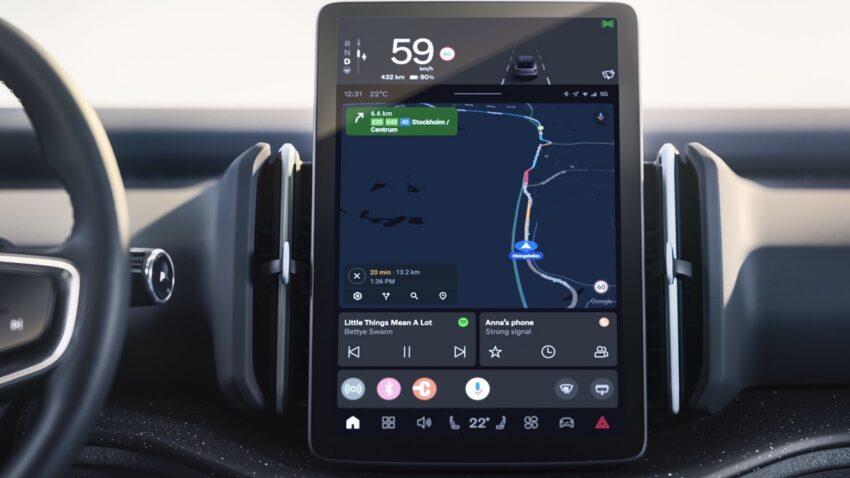
The whole system operates with Google’s Android Auto system and is powered by Qualcomm’s Snapdragon Cockpit platform. It has pretty decent voice controls for basic functions such as initiating phone calls, setting climate controls, adjusting the audio system and setting navigation destinations or searching out nearby charging stations or restaurants. It won’t open the glove box by voice, though, or adjust drive modes or steering and other vehicle settings.
It’s all do-able, but it requires the driver to look slightly right and down and that’s something – many other automakers are guilty of this as well – that we think ought not be done. The UX or user interface in the 2025 EX30 requires more of this, forcing drivers to pull over and stop to make some changes because they have to plow through multiple menu layers; a lot was improved for 2026 with the addition of dedicated on screen icons for some of the most-used controls.
There are a few physical controls as well, but even those require a bit of a learning curve – to save space (and cost?), for instance, Volvo uses just two switches for the four side windows – you have to toggle a switch to change the controls between front and back windows.
Most irritatingly – Volvo outfitted the EX30 with an overly sensitive driver awareness system – a camera that tracks the driver’s eye movement and is constantly activating warning chimes even if all you are doing is glancing that the touchscreen to see how fast you are going – did we mention that there’s no driver info screen on the dash in the driver’s line of sight? That, too, has been moved to the center screen.
You can get used to and even comfortable with using this single-screen system, but it takes an effort and adds another layer of driver distraction.
Standard equipment by trim
The 2026 EX30 lineup offers single- and twin-motor versions in the Plus trim as well as twin-motor Ultra and Cross County Ultra trims. The 2025 model year was limited to the twin motor Plus and Ultra trims.
EX30 Plus
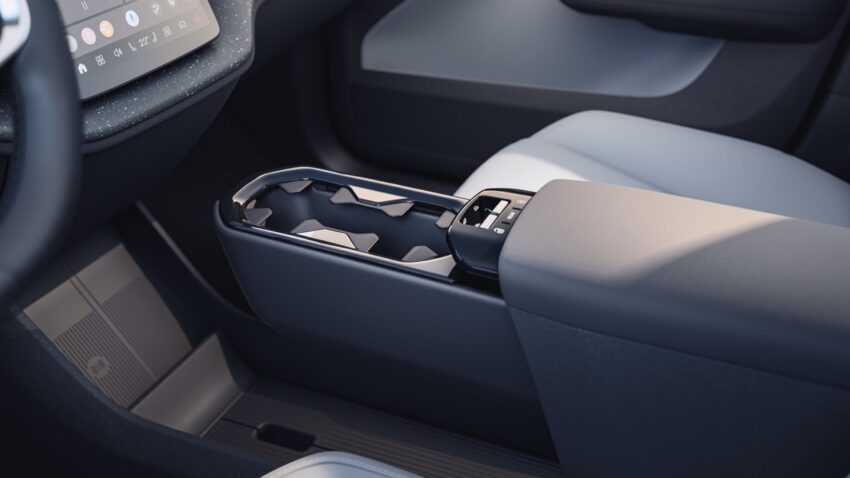
The base Plus trim starts at $40,345 including a $1,395 destination charge. Bumping up to the Twin-Motor Performance powertrain boosts the starting price to $46,345. With either powertrain, the Plus trim comes with 19-inch alloys fitted with run-flat tires; all-LED exterior and interior lighting; a power tailgate; a panoramic glass roof, heated steering wheel and heated front seats with a power-adjustable driver’s seat; fabric-and-faux leather upholstery; a center-mounted, 12.3-inch combination infotainment-vehicle controls touchscreen with driver information display; wireless smartphone charging; front and rear USB-C ports, wireless Apple CarPlay and Android Auto capability, a dual-zone climate control system, and a nine-speaker Harmon Kardon audio system with five of the speakers located in a thin soundbar that spans the top of the dashboard.
Safety and driver assist system on the EX30 Plus trim include front and rear collision avoidance and mitigation with pedestrian, cyclist and intersection traffic recognition and avoidance assist; adaptive cruise control with full stop-and-go capability; lane keeping assist; front and rear cross traffic alert, and driver awareness alert.
EX30 Ultra
Starting at $48,045 with the twin-motor powertrain, the Ultra trim includes all Plus equipment and adds Volvo’s hands-on Pilot Assist driving assistance system with all-speed following, lane centering and automated lane changing; automated parking assist; a 360-degree 3D-view camera system, and automated emergency braking to help mitigate low-speed rear backup accidents.
EX30 Cross Country Ultra
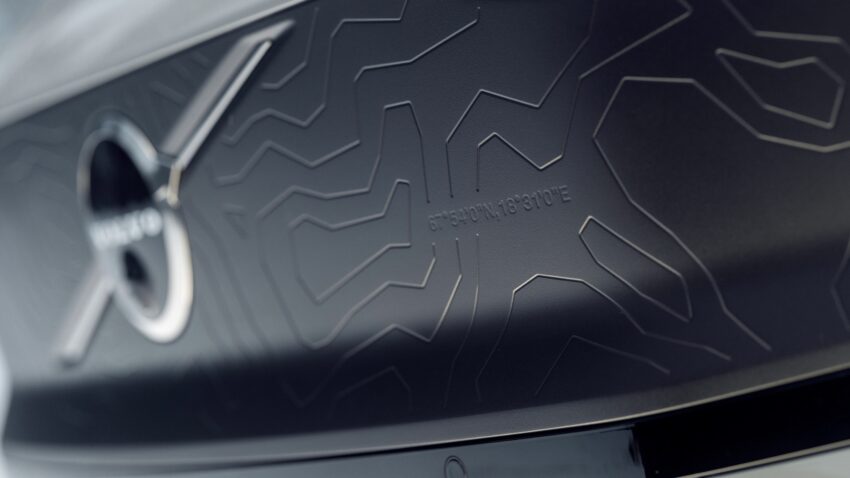
The top-of-the-line model starts at $49,545 and is available only as a 2026 model. It has all the equipment of the standard Ultra, comes only with the twin-motor, all-wheel drive powertrain, and adds a specially tuned suspension with added ground clearance; wheel arch flairs; blacked-out front and rear fascia panels with topography lines from Sweden’s Kebnekaise Mountain etched in the front panel; front and rear skid plates, and optional all-terrain tires with 18-inch wheels.
Would we buy one used?
Sure.
As a new vehicle, The EX30 had to compete against every other $40,000-plus EV and that was a tough chore. As a a used vehicle, though, competing in a lower proice range, it has a lot going for it in a second-car role: it’s small, quiet, quick, easy to park, nicely equipped and distinctly Volvo. Both the single- and twin-motor versions – even the Cross County – have enough range for most households’ daily requirements.
It has limitations. The back seat and cargo areas are small. Range isn’t spectacular. The touchscreen-dependent control system won’t appeal to everybody.
But these are things that are much easier to live with when a vehicle isn’t expected to be the family’s only car.
The first wave of off-lease EX30s should tell a lot. If depreciation and market conditions pushe clean, low-mileage examples into genuinely attractive pricing territory, the little Volvo EX30 could be an EV that makes much more sense at three years old than it did at three months old.